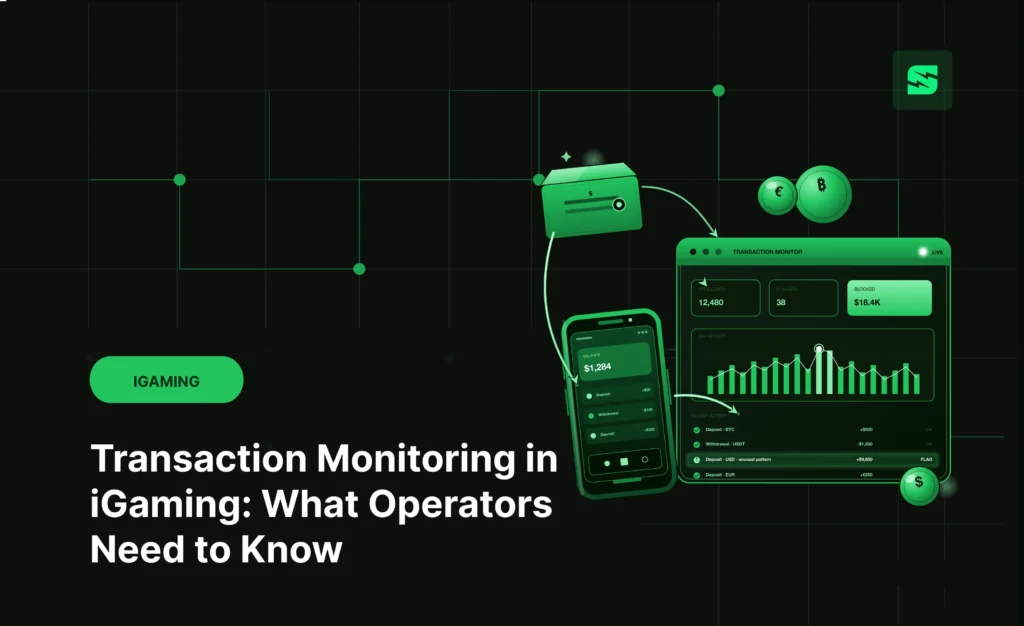
Transaction monitoring in iGaming is the continuous review of player deposits, withdrawals, and other payments to identify activity that doesn't match what an operator knows about the player. Online casinos and sportsbooks use it to spot possible money laundering, payment fraud, and account abuse, and to support their anti-money laundering (AML) obligations. A monitoring system flags unusual activity; a trained compliance analyst then decides whether it has a legitimate explanation or needs further action.
This guide explains how iGaming transaction monitoring works, which red flags operators watch for, what an effective system includes, and where the field is heading.
What is transaction monitoring in iGaming?
Every deposit, bet, and withdrawal tells a small story about a player, and transaction monitoring is how online casinos and sportsbooks read those stories at scale.
It tracks the money flowing in and out of player accounts and checks whether it still fits each player's history, risk level, and, where needed, source of funds.
How transaction monitoring works in online casinos and sportsbooks
Each payment is enriched with KYC, gameplay, and device data, then scored against rules and the player's own baseline. If something looks off, an alert goes to a compliance analyst, who closes it with a reason, requests enhanced checks, or escalates it to the MLRO. Every decision is recorded and used to fine-tune the rules, as shown in the diagram below.
Most payments pass straight through; only flagged activity reaches an analyst, whose decision is recorded and used to tune the rules.
1. Payment Event
Every deposit, withdrawal, refund, or failed payment attempt creates a record linking the player, payment method, amount, and time.
2. Data Enrichment
The record is combined with KYC details, gameplay history, and device data, so each payment is seen in full context.
3. Rules & Risk Scoring
The system checks the activity against monitoring rules and the player's own baseline, then assigns a risk score.
4. Alert or Approve
Most payments pass straight through. If a rule or score crosses a set level, an alert is raised and queued by priority.
5. Analyst Review
A compliance analyst reviews the history and documents, then closes the alert, requests enhanced checks, or escalates it to the MLRO.
6. Record & Improve
Every decision is documented for audits and fed back into rule tuning, so monitoring gets more accurate over time.
Why transaction monitoring is essential for iGaming businesses
Fast payments, global players, and dozens of payment methods make online gambling an attractive target for criminals, and the FATF has warned about platforms being used to move money without real play. Monitoring helps operators spot these risks in their own data before they become losses or regulatory problems.
Detecting money laundering and suspicious financial activity
Laundering through gambling often looks normal one transaction at a time. Monitoring connects the dots across days, accounts, and payment methods, such as many small deposits followed by one large withdrawal. The result is a short list of accounts that genuinely need a human review.
Preventing payment fraud and account abuse
Stolen cards, account takeover, bonus abuse, and chargeback fraud all leave traces in payment data. For example, you can stop a new card added minutes before a withdrawal, before money leaves the platform. Fewer chargebacks also keep relationships with payment providers healthy.
Managing financial and regulatory risks
Where AML law applies, regulators expect monitoring to match the operator's own risk assessment, and the UK Gambling Commission has criticized operators when the two didn't align. Weak controls can lead to penalties, license conditions, and lost banking partners.
Protecting players and building trust
Well-tuned monitoring lets honest players withdraw without unnecessary checks, while hijacked accounts get frozen before balances disappear. Fair, predictable controls keep players loyal and support long-term player lifetime value.
Common red flags in iGaming transactions
Red flags signal review, not proof of wrongdoing: the FATF notes that one indicator alone rarely points to money laundering, while several together justify a closer look. These are the patterns operators watch most closely.
- Unusual deposit and withdrawal patterns
Watch for sudden changes in amount, frequency, or timing, such as a dormant account receiving a large deposit. Many small deposits kept just under a due diligence threshold, known as structuring, are another classic sign. A payday deposit or a bigger stake during a big tournament, however, is usually normal.
- Rapid deposits followed by immediate withdrawals
Money that goes in and comes out with little or no play suggests the platform is being used to clean funds, not to gamble. The risk grows if the withdrawal goes to a different account than the deposit came from. A player cashing out a genuine win is different, so analysts check wagering, not just speed.
- Multiple payment methods or accounts
Payment methods in other people's names, or several accounts sharing a card, device, or address, can point to fraud, bonus abuse, or mule networks. Frequent failed deposits may signal stolen card testing. Using a card and an e-wallet in the same month is normal, so the signal is mismatched ownership, not variety.
- Transactions inconsistent with a player's profile
Stakes far above a player's known means or a sudden shift in account behavior can justify a source-of-funds check. For example, a player who deposits small amounts monthly for two years and then deposits many times that in one week would normally prompt a review.
Key components of an effective iGaming transaction monitoring system
Whether an operator buys monitoring software or builds it around its player account management (PAM) platform, the same five building blocks do the work. Each one covers a gap the others leave.
Real-time and near-real-time transaction analysis
High-impact checks, such as screening a withdrawal request, must run before money moves. Slower patterns, like small deposits spread across a week, are better caught in near-real-time or daily batches.
Key: put the strictest real-time checks on withdrawals and payout detail changes.
Risk scoring and player profiling
Each player has a risk profile based on identity, country, payment methods, and history, and it updates as behavior changes. Transactions are scored against both general rules and that player's own baseline.
Key: combine several weak signals into one score instead of reacting to a single loud one.
Rule-based monitoring and behavioral analytics
Rules catch known patterns, such as a withdrawal soon after a deposit with little wagering, and are easy to explain to auditors. Behavioral analytics compares players with their peers and past activity to find what no rule describes yet.
Key: use rules for known risks and analytics for new ones.
Automated alerts and case management
When a rule or score crosses a set level, the system creates an alert and queues it by priority. Analysts work on each alert inside a case file that stores the evidence, actions, and final decision.
Key: keep an audit trail of who decided what, when, and why.
Integration with KYC, AML, and payment systems
Monitoring needs data from payment gateways, the PAM, KYC providers, sanctions screening, and fraud tools. When these systems share data, a fraud alert can raise a player's AML risk score, and a failed KYC check can automatically pause withdrawals.
Key: link payment and gameplay data first; the right depth beyond that depends on your platform architecture.
The role of AML and KYC in transaction monitoring
Transaction monitoring is one part of a wider AML framework: KYC and due diligence tell the operator who the player is, and monitoring checks whether their activity still fits that picture. The table below shows how each control works and where it connects to monitoring.
| Control | What it does | Role in monitoring |
|---|---|---|
| KYC | Verifies identity, age, and location | Sets the baseline for comparing activity |
| CDD | Builds the player's risk profile | Shapes rules and alert thresholds |
| EDD | Checks source of funds for higher-risk players | Often triggered by monitoring alerts |
| Sanctions screening | Matches names against sanctions lists | Separate check: who, not how they behave |
| Suspicious activity report | Formal report to the authorities by the MLRO | Final step after an investigation |
Transaction monitoring challenges for iGaming operators (and how to prevent them)
Most monitoring problems come from scale, complexity, and conflicting goals rather than from a lack of tools. Operators must check large volumes of payments, keep payouts fast and satisfy regulators in every market at the same time. Each challenge below includes practical ways operators can reduce its impact.
High transaction volumes and payment complexity
Traffic spikes around major sporting events can bury a compliance team in alerts while players expect quick payouts. Payment complexity adds to the load, because each provider returns data in its own format and at its own speed.
- How to prevent it: reserve real-time checks for high-impact moments such as withdrawals and payout detail changes, and batch the rest on infrastructure that can scale without a full platform rebuild. Prioritize queues by risk score so analysts work the most serious cases first.
Balancing fraud prevention with player experience
Every withdrawal hold or document request costs goodwill, and honest players rarely understand why. Too many checks push players towards competitors or unlicensed sites, while too few leave the operator exposed.
- How to prevent it: scale checks to risk instead of applying them to everyone, and ask for documents once, clearly and with a reason. Set internal review times so legitimate payouts are not left waiting for days.
Reducing false positives without missing genuine risks
A queue full of alerts that close with no action drains staff time and hides the cases that matter. Cutting alerts carelessly is just as risky, because it can remove coverage of a real threat.
- How to prevent it: set thresholds by player segment, exclude known-good patterns such as refunds to the original payment source, and fix data matching errors. Test every rule change before release and compare alert outcomes before and after.
Monitoring multiple payment methods and currencies
Cards, bank transfers, e-wallets, vouchers, and crypto each return different data, and currency conversion makes amounts hard to compare. The FATF flags cash, e-wallets, mobile money and virtual assets as payment types vulnerable to laundering.
- How to prevent it: normalize transactions into one data model with a base currency, and record the payer's name and instrument owner where available. Add method-specific rules where generic ones fall short, such as checks on wallet ownership for crypto payments.
Meeting different regulatory requirements across markets
Multi-market operators face different thresholds, EDD triggers, reporting channels, and record retention rules under each license. A control that satisfies one regulator may fall short for another.
- How to prevent it: keep a per-jurisdiction obligations map and build rules that can be configured by market. Assign a responsible owner for each license and review the map whenever regulators publish changes.
Ready to Start Your Project?
Turn your idea into reality with expert support. Our team delivers full-cycle development.
Best practices for iGaming transaction monitoring
Strong monitoring comes from steady habits, not a single tool. These practices reflect common industry expectations, and each operator should adapt them to its licenses and payment mix.
Apply a risk-based monitoring approach
Focus the closest scrutiny on the products, markets, payment methods, and players that carry the most risk. Low-risk activity can then flow with less friction, and every rule should trace back to a named risk.
Review rules and thresholds regularly
Track how often each rule fires and how often it leads to escalation, then fix or retire the ones that add only noise. Review the rule set after any new market, payment method, or regulatory change.
Connect transaction data with player behavior
Payment data alone can't show that a deposit was withdrawn without real play. Linking payments with gameplay, login, device and bonus data shows the full story behind each alert.
Maintain clear investigation records
Record every alert decision, including closures with no action, along with the evidence and reasoning. Good records make audits easier and show where rules need tuning.
Protect personal and financial data
Limit access to monitoring data to those who need it, and log every access. Align AML record-keeping with data protection rules such as the GDPR, so retention periods are clear to everyone.
The future of transaction monitoring in iGaming
Monitoring is shifting from fixed rules to systems that learn from data and map connections between accounts, in a sector the FATF describes as increasingly online and cross-border. These four trends will shape what comes next.
AI and machine learning for anomaly detection: Machine learning models learn what normal activity looks like and flag behavior for which no rule has been written yet. They can also rank alerts so analysts see the riskiest cases first.
Behavioral analytics and network-based risk detection: Network analysis links accounts through shared devices, cards, addresses, and fund flows. This exposes mule rings and collusion that look harmless on an account-by-account basis.
Real-time payments and evolving fraud patterns: Instant transfers and fast e-wallet payouts leave less time to stop a fraudulent withdrawal. Fraudsters also adapt quickly, switching payment methods once a rule catches them.
Explainability, human oversight, and regulatory expectations: Analysts must see why an alert fired and explain the outcome to a regulator. Black-box models make that hard, especially as automation grows across iGaming operations.
Conclusion
Transaction monitoring in iGaming helps operators see when payment activity stops matching what they know about a player. It supports AML compliance, cuts fraud losses and protects honest players from both criminals and unnecessary friction. The strongest programs combine risk-based rules, connected data, automated alerts, and experienced analysts who make and record the final decisions. Requirements still differ by jurisdiction and license, so each operator needs controls built around its own obligations and risks.
FAQ
What is transaction monitoring in iGaming?
Transaction monitoring in iGaming is the ongoing review of player deposits, withdrawals, and other payments to detect activity that does not fit the player's known profile. Online casinos and sportsbooks use it to identify possible money laundering, payment fraud and account abuse.
Is transaction monitoring a legal requirement for online casinos?
In many regulated markets, yes, under AML rules. UK casino operators, for example, must carry out ongoing monitoring that includes scrutiny of transactions. The exact requirements depend on the jurisdiction, license type, and products offered.
What is the difference between transaction monitoring and KYC?
KYC verifies who a player is, usually at registration and at set triggers. Transaction monitoring checks whether that player's ongoing payment activity still matches what the operator knows about them. The two work together within an AML program.
What are the most common red flags in iGaming transactions?
Common red flags include deposits withdrawn with little or no play, payment methods registered to other people, several accounts sharing a card or device, many small deposits that appear to avoid thresholds, and spending far above a player's known means. Each is a reason to review, not proof of wrongdoing.
Stay Ahead of Suspicious Transactions
Effective transaction monitoring helps iGaming operators identify unusual payment activity, reduce fraud risks, and strengthen AML controls.