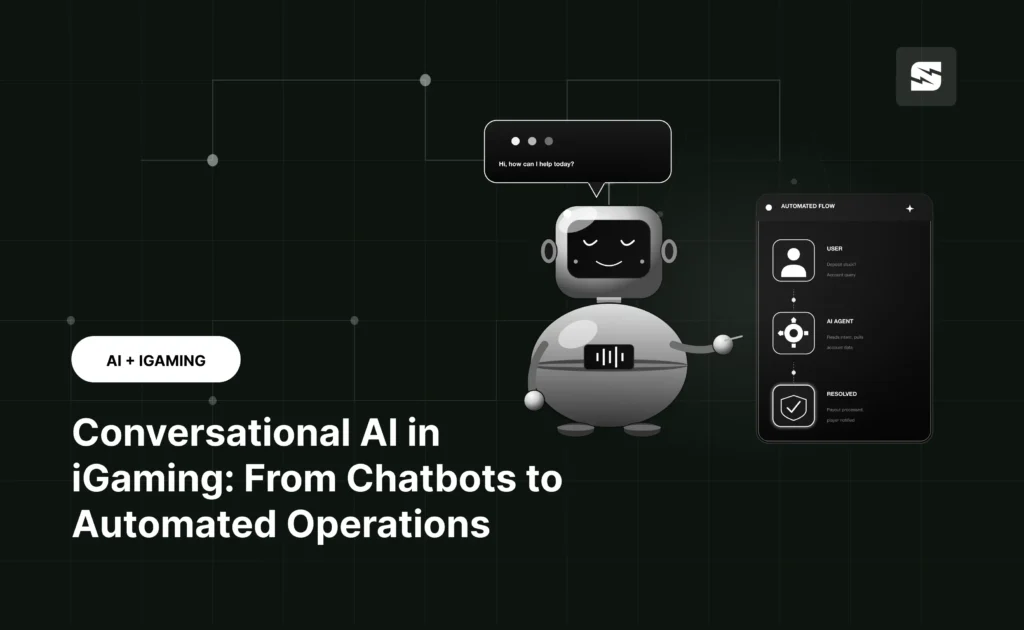
Most iGaming operators already run a chatbot. Few get much out of it. The typical bot answers "how do I verify my account?" and hands everything else to a human agent, often after the player has typed the same question three times.
Conversational AI in iGaming is software that talks with players and staff in natural language and connects to the casino or sportsbook platform to answer questions and take actions. It has moved through three stages: scripted chatbots that follow fixed menus, AI assistants that understand open questions, and AI agents that complete tasks across systems.
This guide explains what conversational AI in iGaming actually covers in 2026-2027, where it pays off, what it takes to build, and where operators should keep a human firmly in charge.
What conversational AI means in iGaming
The terms get mixed up, so it helps to separate them.
- Chatbot. A scripted bot built on buttons, keywords, and decision trees. It handles a fixed set of questions and breaks when a player phrases things differently.
- Conversational AI assistant. A system built on a large language model (LLM) that understands natural language, answers from a knowledge base, and keeps context across a conversation.
- AI agent. An assistant that can also act: check a withdrawal, apply a bonus, update a ticket, or pull a report through connections to the platform's systems.
It rests on three parts: a language model that understands and writes text, a knowledge layer with help articles, terms, and bonus rules, and connections to platform data. The third part decides how useful the whole thing is.
How conversational AI is changing online casinos
The change also reaches beyond support. The same layer can guide a new player through registration, explain why a deposit failed, or prepare a short brief for a VIP manager before a call. It becomes a way into the platform, not just a help widget.
For a wider look at where AI fits into casino products, see our overview of how AI is transforming the online casino industry.
Chatbots vs AI-powered conversational agents
The terms get mixed up, so it helps to separate four levels.
Rule-based chatbots follow scripted decision trees. They match buttons or keywords to prewritten answers. They are predictable and cheap, but they break when a player phrases a question differently or asks two things at once.
AI chatbots use natural language processing to understand free-form questions and answer from a knowledge base. They handle varied wording well, but usually can't see the player's account, so answers stay general.
Conversational AI adds conversation memory and access to player context. It can tell a player that their specific withdrawal is waiting for a proof-of-address document, not just explain how withdrawals work.
Agentic AI, or AI agents, can plan and carry out multi-step tasks with tools the operator provides, such as APIs to the CRM, payment system, or ticketing tool. It acts only within the permissions and business rules the operator sets.
| Capability | Traditional chatbot | Conversational AI | AI agent |
|---|---|---|---|
| FAQ responses | Scripted answers to fixed questions | Natural-language answers from a knowledge base | Same, plus answers drawn from live system data |
| Context understanding | One message at a time | Remembers the conversation and basic player context | Combines conversation history with data pulled from connected systems |
| Personalization | None or simple segments | Adapts answers to the player profile | Adapts answers and next steps to profile and history |
| System integrations | Rare | Mostly read-only access | Read and write access through APIs, limited by permissions |
| Executes actions | No | Limited, usually hands over | Runs predefined actions within business rules |
| Multi-step workflows | Fixed scripted flows | Guides the player through steps | Plans and runs steps across several systems |
| Human handoff | Manual or keyword-based | Triggered by intent or frustration, with a summary | Rule-based escalation with full case context |
How conversational AI improves the player experience
For players, the main gain is simple: fewer waits and fewer generic answers. Conversational AI handles the routine parts of the journey so human agents can focus on cases that need judgment.
24/7 AI-powered player support
A player who deposits at midnight and can't find their bonus shouldn't wait until the morning shift. AI-powered player support covers every hour with the same quality, including weekends and public holidays. Complaints, disputes, and anything involving a vulnerable player still need a clear route to a person, even at night.
AI-powered player support covers every hour at the same level of quality, including weekends and public holidays.
Personalized recommendations and promotions
Because conversational AI can read the player profile, it can answer "what can I play with my free spins?" with the actual eligible games, not a link to the full terms.
The same logic works for promotions. If a player asks about cashback, the AI can check whether they qualify, explain the conditions in plain words, and show the offers that match their activity.
Multilingual support for global players
Modern language models understand and write in dozens of languages, helping operators serve several markets with one support setup.
Many operators keep native-speaking agents for their key markets and let AI cover smaller languages and off-hours. That mix keeps costs reasonable without lowering the quality where it matters most.
How much does conversational AI cost for an online casino?
There is no single price for conversational AI in iGaming. Cost depends mainly on how many workflows you automate, how many systems the AI connects to, and how strict your security and compliance requirements are.
| Cost factor | Impact on cost |
|---|---|
| Number of workflows | High. Each workflow needs design, rules, testing, and monitoring |
| Integrations | High. Often the largest share of development effort, especially with older platforms |
| AI model complexity | Medium. Affects quality, speed, and per-conversation running costs |
| Languages | Medium. Grows with each language that needs reviewed content and testing |
| Voice capabilities | High. Adds speech technology, telephony, and stricter latency requirements |
| Security requirements | Medium to high. Data masking, access controls, and audit logs are essential for regulated operators |
| Analytics | Low to medium. Basic reporting is simple, while warehouse integration takes more work |
| Maintenance | Ongoing. Covers model costs, content updates, monitoring, and improvements |
Conversational AI use cases in online casinos
The strongest use cases share three traits: high volume, clear rules, and accessible data. Below, each one is broken into what the AI does, how it fits the workflow, and what the operator gets from it.
Customer support automation
What the AI does: answers questions about accounts, games, bonuses, and payments, using the player's own data.
How it connects: it reads from the knowledge base and platform APIs, and creates a ticket with a summary when it can't resolve the issue.
What the operator gains: a shorter queue, faster first replies, and agents who spend their time on complex or sensitive cases.
Player onboarding and KYC assistance
What the AI does: explains which documents are needed, why they are needed, and what a valid upload looks like. It can flag blurry or cropped photos before they reach the verification provider.
How it connects: it reads the verification status from the KYC provider and passes uploads into the existing process. The provider and the compliance team still make the decision.
What the operator gains: fewer rejected documents, fewer abandoned registrations, and less back-and-forth for the compliance team. Our article on KYC and AML in online iGaming covers the compliance side in detail.
Payment and withdrawal support
What the AI does: shows real-time deposit and withdrawal status, explains common decline reasons, and lists the payment methods available in the player's country.
How it connects: it gets read access to the payment system and cashier. Refunds, reversals, and manual approvals stay with the payments team.
What the operator gains: "Where is my money?" is one of the most common contact reasons in iGaming, and a clear, accurate answer removes a large share of those tickets. For crypto-enabled brands, the AI can also explain network confirmations and wallet addresses, topics covered in our piece on crypto payments in iGaming.
Bonus and promotion assistance
What the AI does: explains wagering progress, eligible games, expiry dates, and why a bonus didn't apply.
How it connects: it reads from the bonus engine and the player's bonus history.
What the operator gains: fewer bonus disputes and clearer communication of terms, which also supports fair player treatment.
Responsible gambling support
What the AI does: explains deposit limits, time-outs, and self-exclusion, and helps players set them up. It can surface signs of distress in a conversation for staff to review.
How it connects: it links to the operator's safer gambling tools and escalation rules. Concerns go to trained staff, not to an automated decision.
What the operator gains: players can reach safer gambling tools at any hour, and staff get earlier warning of possible issues. We look at this in more detail below.
VIP player management
What the AI does: answers routine VIP questions instantly and prepares briefs for account managers covering recent activity, open issues, and preferences.
How it connects: it reads from the CRM and hands conversations to the assigned manager when the player asks for a person or the topic needs one.
What the operator gains: VIP managers spend less time on admin and more on the relationship. If your CRM can't support this kind of data flow, casino CRM development is often the place to start.
Ready to Start Your Project?
Turn your idea into reality with expert support. Our team delivers full-cycle development.
How to implement conversational AI in iGaming
Operators that get value from conversational AI usually start small, measure carefully, and expand only what works. Here is a practical path from idea to production.
Identify the right automation opportunities
Start with your own data, not with a vendor demo. Export a few months of support tickets and chat logs and group them by contact reason.
Look for topics that score high on three points: frequent, rule-based, and answerable from data you can reach. Withdrawal status, document requests, and bonus wagering progress often qualify. Complaints, disputes, and safer gambling cases are better kept with people at first.
Choose the right AI technology
The choices fall into a few layers:
- Language model: a commercial model through an API, an open-source model hosted by you, or a mix. Weigh quality, speed, cost, and where data is processed.
- Orchestration: the layer that manages conversation state, calls tools, applies business rules, and handles handoffs.
- Knowledge retrieval: how the AI finds the right help article or bonus rule, usually by searching your approved content rather than relying on the model's general knowledge.
- Channels: website chat, mobile app, messaging apps like Telegram, email, or voice.
Avoid locking the whole system to one model. Models improve, and prices change, so a design that lets you switch models protects the investment.
Integrate AI with existing systems
Start with read-only access to the systems your first workflows need. Add write actions one at a time, each with its own permissions, confirmation steps, and fallback when an API fails. If your product runs on online casino software built for integrations, this stage moves much faster.
Test, monitor, and optimize AI performance
Before launch, test the AI with real historical questions, tricky edge cases, and deliberate attempts to break its rules. Include compliance and safer gambling staff in the review.
The future of conversational AI in iGaming
The direction is clear even if the pace isn't: AI will take on more operational work, but within limits set by regulators and operators. It helps to separate what already works, what is spreading, and what is still ahead.
AI agents taking on more operational tasks
In use today: AI that answers account and payment questions from live data, drafts replies for human agents, and summarizes cases.
Becoming more common: agents that run multi-step workflows across CRM, KYC, and ticketing, with humans approving the sensitive steps.
Further ahead: agents that coordinate with each other, for example, a support agent handing a case to a compliance agent that prepares it for review. The technology exists in early forms, but making it reliable and auditable in a regulated business still takes serious work.
Hyper-personalized player experiences
Personalization will likely move from segment-level campaigns toward individual conversations that reflect each player's history, preferences, and language.
Regulation will shape how far this goes. Rules on marketing, bonuses, and safer gambling already limit what operators can offer and to whom. The operators that benefit most will use personalization to make the experience clearer and safer, not just to push more offers.
Voice AI and multichannel casino support
Voice AI has improved quickly, with speech recognition and natural-sounding voices now good enough for many support calls. AI voice agents for casinos can handle routine phone queries, VIP callbacks, and after-hours lines, with an option to transfer to a person.
The bigger shift is continuity across channels. A player might start in website chat, continue in a messaging app, and finish on a call, with the AI keeping the full context. Messaging-first products, such as Telegram casino platforms, already make conversational interfaces the main way players interact.
From AI chatbots to autonomous casino operations
Fully autonomous casino operations remain a direction, not a current reality. Licensing rules, AML duties, safer gambling requirements, and the EU AI Act all expect human accountability for important decisions.
The realistic future is a casino where AI handles most routine work and humans focus on judgment, relationships, and oversight. Operators who build clean integrations, solid governance, and good data now will be ready to automate more as rules and technology allow.
Conclusion
Conversational AI in iGaming has moved past the scripted chatbot. Today's systems understand context, read live player data, and carry out defined tasks inside the casino's own workflows.
The value doesn't come from the model alone. It comes from good integrations, clear business rules, and human oversight where money, compliance, and player wellbeing are involved. Operators who start with a few high-volume workflows, measure results, and expand carefully tend to get the most. The move from chatbots to automated operations is gradual. The groundwork you lay now, including clean APIs, reliable data, and solid governance, decides how far and how safely you can go.
FAQ
What is conversational AI in iGaming?
Conversational AI in iGaming is software that lets players and staff interact with a casino platform in natural language. It understands questions, uses player and platform data to answer them, and can perform predefined actions such as checking a withdrawal status or opening a support ticket. It is used mainly for player support, onboarding, and operational workflows.
What is the difference between a casino chatbot and an AI agent?
A casino chatbot answers questions from scripts or a knowledge base, usually without access to the player's account. An AI agent connects to casino systems through APIs and can carry out multi-step tasks, such as checking a payment, requesting a document, and updating the CRM. Agents act only within the permissions and rules the operator sets.
Can AI approve withdrawals or complete KYC checks on its own?
In most setups, no. AI usually shows payment and verification status, explains what is missing, and passes documents into the existing process. Decisions to approve withdrawals, accept documents, or close accounts usually stay with the payments and compliance teams because they carry regulatory and financial risk.
How does conversational AI support responsible gambling?
Conversational AI can help players set deposit limits, take time-outs, or self-exclude at any hour. It can also flag signs of concern in conversations, such as chasing losses, for trained staff to review. It does not diagnose gambling problems. It supports processes designed by the operator's compliance team.
Ready to see which parts of your support and operations AI can take on?
Contact Simpltry to discuss your platform, and we will help you map the first workflows worth automating.