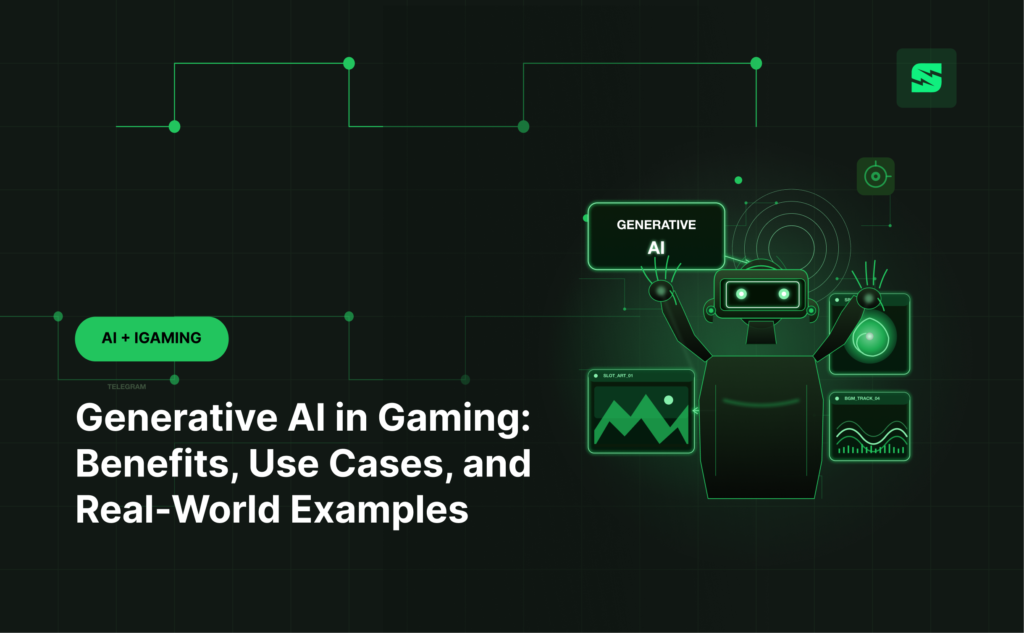
Generative AI is changing game development by helping teams create content faster, automate parts of the creative process, and explore new ways to build interactive experiences. It can support everything from generating game assets and designing environments to creating content that adapts during gameplay.
This article explores the main benefits and use cases of generative AI in game development, with real-world examples of how developers are using it for asset generation, game design, and runtime applications.
Why generative AI is reshaping game development
| Development Area | Generative AI | Impact |
|---|---|---|
| Design | Generates concepts and prototypes. | Faster iteration |
| Art & Assets | Creates images, textures, and 3D assets. | More content, less manual work |
| Code | Assists with code and debugging. | Shorter development cycles |
| World Building | Helps create environments, NPCs, and dialogue. | Larger, richer game worlds |
| Testing | Supports testing and bug detection. | Faster feedback |
Where generative AI creates the biggest impact in gaming
Artificial intelligence can help with many aspects of development, particularly search, but it has its greatest impact in areas that require large amounts of content, interaction, or duplication. Whether it’s creating assets, running game tests, or testing mechanical gameplay, artificial intelligence opens up new possibilities for designers.
Content creation and asset production
Artificial intelligence can create concept art, textures, virtual worlds, play environments, character designs, and other play resources. Play developers can test concepts, including variations, before settling on a final version.
NPC interactions plus dynamic dialogue
Artificial intelligence can make NPCs more interactive by generating dialogue that responds to players' current actions. Instead of constantly using single, pre-written dialogue, NPCs will be able to react naturally to what is happening.
Personalized gameplay interactions
Thanks to generative artificial intelligence, certain aspects of the playing experience can be personalized to meet a specific user's needs. Dialogues, quests, challenges, and other aspects of the experience will depend on player choice, playstyle, etc.
Automated testing and quality assurance
Artificial intelligence can automate standard test procedures, emulate different player actions, and find bugs or anomalies, which improves pathfinding in the environment. This lets QA professionals deal with complex situations.
Why generative AI is reshaping game economics
| Economic Area | What AI Changes | Result |
|---|---|---|
| Development Cost | Automates repetitive production work. | Lower costs. |
| Team Efficiency | Supports artists, designers, and developers. | More output from smaller teams. |
| Production Time | Speeds up prototyping and content creation. | Faster time to market. |
| Content Scale | Generates more assets and variations. | More content at a similar cost. |
| Revenue | Enables more personalized game content. | More opportunities for engagement and monetization. |
Key benefits of generative AI in gaming
Creative AI offers developers many advantages in the AI in gaming industry. It optimizes workflows, promotes experimentation with new ideas, creates engaging game experiences, and makes gameplay more exciting, interesting, or even fun.
Accelerated game development cycles
AI can complete tasks that would normally take a lot of time, including asset generation, dialogue writing, and scenario testing, supporting innovation in development. Development teams then have more time for creative work.
Increased creativity and content variety
Generating content with artificial intelligence makes it easier for digital content designers—such as those working on movies, books, plays, and more—by liberating time for critical tasks—such as writing, directing, or acting—instead of spending hours on repetitive work.
Enhanced player engagement and retention
Personalized, interactive content can help you retain gamers for longer. AI can deliver dialogue customized to each player.
Improved scalability regarding live-service games
Online content that evolves constantly requires continuous revisions. Generative AI can create, modify, or extend content, helping developers better serve players' tastes.
Real-world examples of generative AI in gaming
Creative AI, along with natural language processing, is already being researched for useful applications in the entertainment industry. Below are several examples of these implementations, showing the benefits and use cases of creative AI in entertainment, along with specific applications.
- NVIDIA ACE and autonomous game characters
ACE is NVIDIA’s technology that uses generative AI to create interactive game characters that can understand player actions and respond
- Inworld AI and intelligent NPCs
Inworld AI is a company that develops AI solutions with personality, memory, and situational understanding of the surrounding environment, enabling agents to respond abased onhow oeople talk to them.
- Ubisoft's NEO NPC project
Ubisoft's NEO NPC project aims to create AI-powered non-player characters that can communicate more dynamically. This will make NPCs less predictable and more interactive for players.
- AI Dungeon and adaptive storytelling
AI Dungeon is a game in which stories are generated using artificial intelligence and behavior trees. These stories are dynamic and evolve based on what players do.
Ready to Start Your Project?
Turn your idea into reality with expert support. Our team delivers full-cycle development.
What generative AI means for the future of gaming
Generative artificial intelligence in gaming, machine learning, and deep learning could change not only the development process but also how we play after release. This could mean that future titles will be more flexible, respond quickly to player actions, or be formed by players’ individual choices.
Fully adaptive game worlds
In real time, they can adapt to what players do, changing characters, environments, events, and even storylines through procedural content generation.
Personalized game experiences for every player
Artificial intelligence could customize everything—from the difficulty level to quest options—taking into account each player’s preferences and style of play, creating a unique playing experience for each of them.
AI-native game design as a new category
Future titles may incorporate artificial intelligence from the very beginning, rather than after development is complete. Artificial intelligence could become an integral part of the gameplay experience itself.
Shift from “games as products” to “games as systems”
With procedural generation, you can think of your content as constantly evolving systems rather than finished products, guaranteeing players always have new, varied experiences.
Challenges and risks of generative AI in gaming
Creative artificial intelligence offers many benefits to the entertainment industry, particularly through integrating AI into gameplay, but developers also meet challenges they must address.
Intellectual property and copyright matters
AI-created content may raise questions about ownership of the resulting product and what content was used to train the AI. Developers should ensure there are no unanticipated copyright problems.
Content quality and consistency issues
There is no way to ensure computer-generated data is accurate. Strange character actions, inappropriate conversations, and misplaced visual elements are possible.
Ethical aspects and player trust
AI technology may affect gamers' perception of the game and its developers. These fears include AI replacing creativity, collecting users' data, and generating inappropriate content.
The growing debate around AI-generated games
AI-based creations are still controversial. While some see artificial intelligence as a way to create original experiences, others worry about its impact on originality and the role of human creators, a concern also seen with AI in sports betting.
Conclusion
Generative artificial intelligence is fast becoming an essential element of contemporary software engineering because of advances in content generation, character creation, personalization, and even software testing automation. While copyright questions remain, this technology provides strong prospects for the industry's future development.
FAQ
How is generative AI used in gaming?
Creative artificial intelligence is widely used in video production to create elements of virtual worlds—including characters, environments, textures, dialogue, storylines, systems, and visual art. This machine-learning-based technology enables more natural interactions between players’ characters, allows modification of quests or challenges, and helps with programming other repetitive tasks. Similar automation is also becoming relevant in white label sports betting, where ready-made platforms can streamline the development and management of betting products.
Can generative AI create entire video games?
Artificial intelligence can create almost everything needed to develop a video game, including graphics, dialogue, music, code, character design, or even plot ideas. This technology can help developers quickly turn ideas into prototypes or test various gameplay systems. However, humans still need to create a fully fledged product. Designers must define the product concept, integrate its components, fix bugs, check that all elements are functioning properly, and guarantee the final product is engaging for players,
What are the risks of generative AI in game development?
Using generative artificial intelligence to develop software entails several risks. Main concerns involve copyright and intellectual property rights, since computers can generate images, voices, music, or other creative content. In fact, machine-generated content may not meet quality standards, may be inconsistent, or may not suit the context. Ethical issues, such as the displacement of human originality, data privacy, or transparency, can affect players’ experience with AI-produced content.
Will generative AI replace game developers?
Creative AI is unlikely to replace developers, since making a new game isn't simply about generating content. While creative tools can automate standard processes, help with coding, build resources, or run tests efficiently, designers will still come up with ideas and decide which direction to take. As much as possible, this will free up developers' time, letting them focus more on gameplay, story, etc.
Generative AI in Gaming
Explore how AI is changing game development.