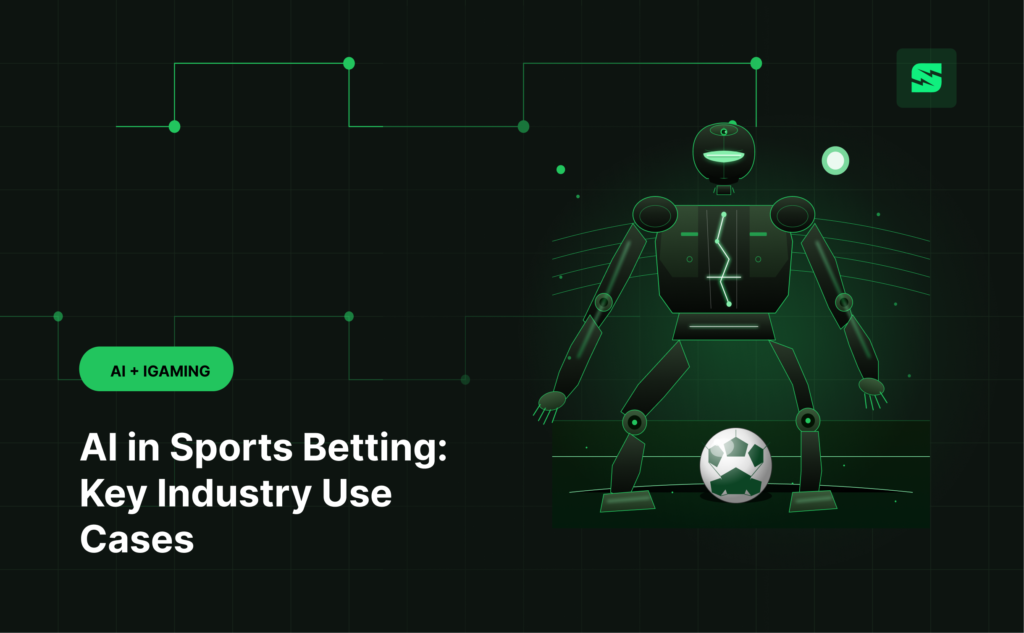
AI is becoming a practical tool in sports betting, helping operators work with large amounts of data, adjust odds, manage risk, and respond to changes in live markets. It can also help identify patterns in player behavior and improve how betting products are built and managed. As operators adopt more technology-driven solutions, the market is also seeing wider use of ready-made options such as white-label casino platforms.
Where AI fits in the betting ecosystem
| Area | AI Role | Result |
|---|---|---|
| Odds | Tracks live data | Smarter pricing |
| Fraud | Flags unusual activity | Better security |
| Players | Personalizes offers | Higher engagement |
| Support | Handles routine requests | Faster replies |
Key use cases of AI in the sports betting industry
AI is changing how bookmakers run their sports betting business by assessing data, making calculated decisions, and quickly adjusting odds.
AI-powered odds setting and market pricing
Artificial intelligence can analyze match data, player statistics, team form, injuries, and other factors to estimate outcomes and adjust market odds. This is also shaping how AI is transforming the online casino industry.
Risk management and exposure control
With artificial intelligence, bookies would be able to manage their odds, volume, or exposure as conditions develop. It can identify anomalies, adjust the odds range, and hence offer risk management.
Fraud detection and integrity monitoring
AI can identify abnormal betting patterns in sports events, something humans find difficult. This allows them to investigate fraud or threats to fair play.
Personalized betting experience
By using AI to understand customer behavior while placing bets, bookies can deliver customized experiences instead of a standardized one.
In-play betting optimization
Thanks to AI, bookmakers can respond instantly to any events that occur during a game. Data from live games can be analyzed to change the odds and markets accordingly.
Technologies behind AI sports betting systems
The AI betting system uses machine learning and other technologies to process large volumes of data, make predictions, and react to market variations.
Machine learning models for prediction and classification
Machine learning algorithms powered by AI are used to make predictions, classifications, analyses of past or current data, trend detection, future forecasting, and ratings of individuals or teams based on certain criteria.
Real-time streaming data architectures
In real-time streaming data, there is information about sporting events that can be used for sports betting or gambling with artificial intelligence.
Big data processing pipelines
Sportsbooks generate significant amounts of data on matches, players, users, etc. A big data processing system processes this data, making it usable by artificial intelligence systems in sporting events.
Natural language processing for news and injury reports
Natural language processing enables artificial intelligence systems that can process large amounts of unstructured data, such as sports news, team reports, player injury reports, etc. This data can improve forecast precision, permitting more knowledgeable decision-making in markets.
Reinforcement learning for dynamic pricing systems
Reinforcement learning is a technique that enables an AI system to learn from changes in its environment and make decisions based on its experience, turning it into an effective strategy for AI in sports betting.
Ready to Start Your Project?
Turn your idea into reality with expert support. Our team delivers full-cycle development.
AI models that power wagering decisions in 2026
Modern bookmakers use machine learning, deep learning, and natural language processing to turn large volumes of sports data into faster, more informed decisions. This directly affects how sports betting odds work, from pricing markets to adjusting odds in real time.
Ensemble models vs single prediction frameworks
An ensemble model uses multiple models to improve forecast precision. The model differs from a single-prediction framework in that it detects separate patterns in the data.
Deep learning for in-play betting reactions
For example, deep learning allows the processing of multifaceted data streams in real time while detecting changes, making it a necessary tool for sports gambling. Thanks to this, deep learning can be applied to in-game odds that change every second.
Reinforcement learning in odds optimization
By using reinforcement learning, a system can learn from dynamic changes in the market environment and adjust its actions based on past events. For odds optimization, reinforcement learning can help sportsbooks adapt their actions to the betting process.
The role of AI in live betting
| Moment | AI Response | Value |
|---|---|---|
| Game changes | Reads events as they happen | Quicker odds updates |
| Market shifts | Reacts to betting activity | Tighter risk management |
| Player behaviour | Learns from betting patterns | More relevant offers |
| High-risk signals | Flags unusual activity | Earlier intervention |
Constraints and difficulties of AI in betting
Artificial intelligence, such as sports-prediction AI, can accelerate and optimize, but not eliminate, the uncertainty inherent in sports betting. Those who use artificial intelligence for sports gambling can gain a competitive advantage by relying on analytics-based insights.
Sports outcomes remain inherently unpredictable
Even the most sophisticated artificial intelligence models are unable, at present, to predict outcomes of sports competitions. Countless unpredictable factors can modify outcomes.
Data quality and delay issues affect accuracy
The effectiveness of AI algorithms depends largely on the quality of data collection, the speed at which that data is gathered, and the quality of sentiment analysis on social media.
Regulatory restrictions differ by jurisdiction
There are various regulatory requirements regarding artificial intelligence technology, odds, data, responsible gaming, etc. A sportsbook must ensure that its artificial intelligence technologies consistently comply with regulatory requirements across all territories, incorporating advances to stay ahead.
Moral concerns around addiction and targeting behavior
Personalization will improve the gaming interaction through offering individualized experiences, but at the same time, ethical issues arise when AI is used to target specific user behavior. It is necessary to think about responsible gambling.
Why AI doesn’t guarantee winning bets
AI can help bettors analyze data and make more informed decisions, but it cannot guarantee winning outcomes. AI use in iGaming is growing, particularly in player analytics, personalization, and risk management.
The limits of forecasting within unpredictable systems
Artificial intelligence can examine patterns in data from past events. It can also predict the possible outcomes of sporting events; however, unanticipated factors can change the course of events at any time.
Data bias and model overconfidence
Artificial intelligence models need data to learn from and generate predictions. If the data is biased, outdated, or partial, incorrect conclusions can be reached. Another factor that may distort predictions is overconfidence caused by incomplete data.
Why sportsbooks still win long-term
Odds set by a bookmaker already include a margin, which means bookmakers always have an edge. Although artificial intelligence technologies can help control odds, they cannot eliminate bookmakers' advantage.
Conclusion
Technologies, particularly artificial intelligence, are increasingly used in gambling for odds prediction, risk management, fraud detection, personalizing the user experience, optimizing betting, and providing in-game odds, among other areas, exhibiting how technology is changing the industry. Despite this, artificial intelligence cannot predict everything or guarantee that everyone who places a winning bet will definitely win, as some events are unpredictable.
FAQ
Is AI actually used in sports betting today?
Yes, bookmakers use artificial intelligence technologies for various purposes, including generating personalized experiences for users. Among their most common applications are setting odds, managing risk, detecting fraud, analyzing markets, and supplying personalized customer service. Artificial intelligence can analyze large volumes of information about games or bets much faster than a human. This technology is also used for in-game odds when quick modifications are needed.
Can AI predict sports outcomes accurately?
AI can make valuable predictions via advanced analytics in sports betting, but it can’t predict the outcome of sports events with absolute precision. Machine learning algorithms can use all available data on players' past performance, team performance, injuries, form, historical performance, and so on to estimate probabilities. But an unpredictable event may occur at any time, influencing the game's outcome.
Do sportsbooks rely more on AI or human dealers?
Most bookmakers could profit substantially by combining artificial intelligence with human expertise to perfect decision-making. Specifically, artificial intelligence is effective at processing large data sets, detecting trends, monitoring markets, and responding quickly when situations change. On another note, traders can help form specific opinions when making decisions that an automated system cannot, due to the complexity of those decisions.
What is the biggest advantage of AI in betting systems?
One of its main advantages is its speed in processing huge amounts of data. With its help, bookmakers can improve their odds, track activity, spot anomalies, respond in real time, and even automate common analytical tasks, freeing up operators’ time for decision-making. In addition, artificial intelligence automates routine analytical tasks, freeing up operators’ time for decision-making.
Is AI sports betting legal?
Legal aspects of using artificial intelligence in sports betting differ greatly depending on where you are based or what exactly you want to do. Whether sports gambling is illegal or regulated depends on your region's gambling laws. Still, other factors—such as data protection, responsible gambling, fraud detection, automation, etc.—should also be considered.
AI in Sports Betting
Explore how AI is shaping odds, live betting, risk management, and the player experience.