Processing payments at online casinos can account for up to 10% of gross gaming revenue (GGR). That’s not a rounding error. It’s a cost, multiplied by every payment put into and withdrawn from the cashier as well as every chargeback. In high-friction markets where card acceptance rates are below 60%, this pressure hits hardest.
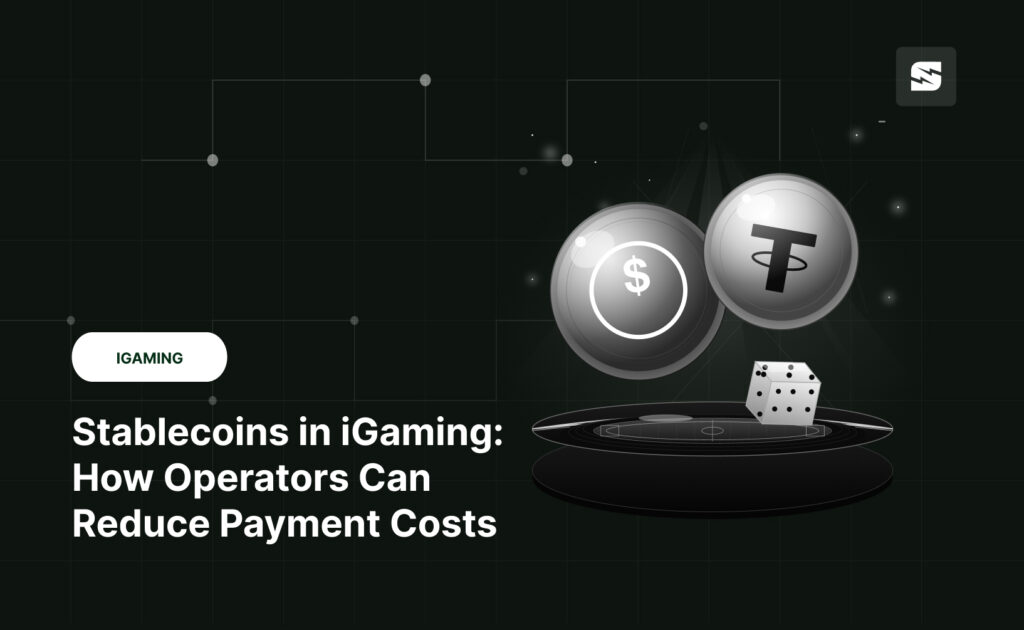
Stablecoins have recently been introduced and are currently being used in the iGaming sector. These dollar-pegged tokens include well-known tokens such as USDT and USDC. The advantages include settling on-chain within minutes and bypassing the card network’s interchange fee. Stablecoin per-transaction fees are often only a fraction of a cent. In this article, we discuss the various fees related to stablecoins, iGaming compliance, and step-by-step implementation guidelines that will help you move from a pilot project to implementing stablecoin payment processing in your main online product.
Why igaming payment costs are a structural problem, not a vendor issue
iGaming payment costs are not a sourcing problem and therefore cannot be solved by better vendor negotiations. These penalties are structural and based on network rules and merchant classification.
- The real cost stack: acquiring fees, chargebacks, FX conversion, and failed transactions
On top of the 3–5% card-acquiring fees for gambling merchants as opposed to sub-1% for e-commerce merchants, Cross-border FX conversion adds 1–3% additional fees; failed transaction rates on card deposits in regulated markets can reach 15–30%. These attempt costs never generate any revenue for the operator.
- How card network rules specifically penalize gambling merchants
The casino merchant category code, MCC 7995, incurs additional risk surcharges from both Visa and Mastercard. Average chargeback rates for online gaming merchants range from 1.5% to 2.5% of online transactions. These rates are above Visa's 0.9% monitoring threshold, so the card schemes classify online gaming merchants in a higher-risk category.
-
- Why switching PSPs alone doesn't fix the underlying margin bleed
New PSPs operate under the same card-network rules and the same MCC classification for Casino merchants as any other PSP. Online gaming payment processing fees don't drop much when you switch acquirers, since card schemes set the floor for online payment processing fees and PSPs can only negotiate with acquirers.
What stablecoins actually are, and why they behave differently as a payment rail
Dollar-pegged tokens are issued on public blockchains. Expensive intermediary layers sit between the public blockchain and the iGaming operator, typical of card rails.
USDT, USDC, and DAI: how peg mechanisms differ and why it matters for operators
USDT and USDC casino deposits account for the largest share of stablecoin volume in iGaming, making the distinctions between these two assets operationally significant. Of the two, Circle's USDC is fully reserved and therefore auditable. Tether's USDT holds a larger market share, but less is known about its reserve composition.
On-chain settlement vs. Traditional correspondent banking: the latency and cost gap
All Tron and Polygon transactions are finalized within seconds for less than $0.01 per transaction. In contrast, Card rails take 1–3 business days to clear and can cost the operator up to 4% in interchange and scheme fees per transaction.
Programmable money: smart contract escrow, auto-payouts, and provable reserves
Programmable payments enable automated payouts for winnings, affiliate commissions, and other bonuses. Smart contracts pay out money automatically, thus eliminating the need for intervention by the online casino's treasury department. Payments made with stablecoins do not pose price-exposure risk, so the value of payments received equals the value of payments made.
Fee comparison operators need to compare cards vs. stablecoins vs. bank transfers
For iGaming operators, choosing a payment method is a margin decision. With stablecoins, online gaming operators can make a well-informed decision based on the numbers.
| Factor | Cards | Stablecoins | Bank Transfers |
|---|---|---|---|
| Processing Fee | 3–5% acquiring fee under MCC 7995. | Fractions of a cent per on-chain transfer. | Flat fee per wire, plus correspondent charges. |
| Net on $1,000 Deposit | Roughly $940–$960 after all costs. | Roughly $997–$999 after all costs. | Falls between the two on net amount. |
| Settlement Time | 1–3 business days to clear. | Seconds to minutes, including weekends. | 2–5 business days, often longer cross-border. |
| Chargeback Risk | 1.5–2.5% average, above Visa's 0.9% threshold. | None. On-chain transfers are irreversible. | Very low, but recalls are still possible. |
| Failure Rate | 15–30% declines in regulated markets. | Low, mainly wrong-network sends. | Low, but errors take days to surface. |
| FX Costs | 1–3% on cross-border conversion. | None. Dollar-pegged end to end. | Bank spread plus correspondent markup. |
| Working Capital Impact | Rolling reserves lock up cash for months. | No reserves. Float stays under your control. | Cash tied up during multi-day settlement. |
| Player Experience | Familiar, but declines frustrate depositors. | Instant payouts, needs onboarding for new users. | Slow payouts drive drop-off and support tickets. |
| Best Suited For | Mass-market players in high-acceptance markets. | Crypto-native and high-value depositors. | Large one-off deposits and VIP settlements. |
Stablecoin iGaming Compliance: Regulatory Landscape Operators Must Navigate in 2026
The laws surrounding stablecoin use in iGaming are slowly but surely being clarified and developed. Currently, iGaming operators can obtain a license in 3 ways to allow players to deposit stablecoins into their gaming accounts.
Jurisdictions that explicitly permit stablecoin deposits: Malta, curaçao, Isle of Man, and offshore frameworks
Below are summaries of published information on the use of stablecoins for igaming from the MGA, GSC, and curaçao’s new master license introduced in the 2024 gaming law for all types of gaming activities.
AML and KYC obligations that apply to on-chain payments, FATF travel rule implications
The FATF Travel Rule, as summarized by Elliptic, requires collecting and transmitting originator and beneficiary information for igaming stablecoin deposits. Operators must collect and transmit originator and beneficiary information for cross-border payments exceeding $1,000. Failure to comply with the travel rule could put the igaming operator’s license at risk.
How to structure a compliant stablecoin cashier without triggering licensing red flags
Budgets can range from $500 per month for small deposit volume to $5,000 per month for large deposit volume. Integrating these tools into the cashier flow before funds are credited to players’ accounts is usually enough to pass most crypto casino compliance audits without major changes to the operator’s structure.
Ready to Start Your Project?
Turn your idea into reality with expert support. Our team delivers full-cycle development.
Choosing the right stablecoin stack: networks, wallets, and custody models
Each crypto casino payment solution consists of three components: the chosen network, the wallet architecture, and the custody model. Each solution carries costs and is used in a specific way.
| Stack Layer | Options | Trade-Off | Best Fit |
|---|---|---|---|
| Network | Tron, Ethereum, Polygon, Solana. | Cheap rails vs. better tooling and auditability. | Tron for retail volume, Ethereum for regulated setups. |
| Stablecoin | USDT, USDC. | Player liquidity vs. reserve transparency. | Support both, split by regional demand. |
| Wallet Model | Custodial or non-custodial. | Easy onboarding vs. holding player funds. | Custodial for mass market, non-custodial for crypto-native. |
| Custody | Third-party custodian or self-custody with MPC. | Counterparty risk vs. internal security overhead. | Custodian below $500K monthly, self-custody above. |
| Infrastructure | Processor (CoinsPaid, B2BinPay) or in-house build. | Weeks to launch vs. full control and lower unit cost. | Start with a processor, then move in-house once volume justifies it. |
Player experience: how stablecoin deposits and withdrawals change the ux
Stablecoins for iGaming can turn the cashier from a pain point into a competitive feature. The following 3 UX decisions determine whether players reach this feature.
Wallet connect, QR codes, and reducing address-entry errors
Most stablecoin deposit failures in igaming stem from manual address entry. Wrong-network sends are by far the most common problem for crypto projects. However, using QR codes or wallet-connect integrations can cut errors by as much as 70%.
Withdrawal speed as a retention lever
Within a few minutes, a player can switch to another platform if they can't withdraw their crypto funds in time. This huge difference between same-minute payout and 3-day card payout creates a huge nps difference which can be marketed.
Educating non-crypto players
A good casino cashier experience can be further enhanced by adding an on-ramp to purchase USDC with fiat currencies. Also, by displaying balances in both USD and token units in the player’s account, you can reduce friction in onboarding crypto payments.
Integration roadmap: how to add stablecoin payments to an existing igaming platform
Installing a payment gateway that uses stablecoins will likely take 6-14 weeks, depending on whether you are integrating a payment processor or designing your wallet system. However, you can save yourself this time by following these five steps in order.
Step 1: Audit your existing payment stack
Before starting anything new, map out your current deposit, withdrawal, and reconciliation processes. This will help prevent stablecoin integration from becoming a total rewrite of your processes.
Step 2: Choose your networks, custody model, and stablecoins
Before selecting a provider, understand what matters to you, as this will determine which providers you work with. All providers accept USDT on Tron and USDC on Ethereum or Polygon, but also use other networks.
Step 3: Integrate a processor or build custom infrastructure
Third-party payment processors like CoinsPaid or B2BinPay can be ready to start in weeks and suit casinos handling up to $500,000 in cryptocurrency transactions per month. Building a proprietary wallet solution would take months and would be worth doing only if transaction volume covers all expenses.
Step 4: Build the compliance layer in parallel, not after
Wallet validation, KYC and AML procedures, and data gathering should happen in the same sprint as the cashier module. Implement Chainalysis, Elliptic, or TRM Labs to ensure that incoming addresses have been validated before depositing any funds into a user’s account, and that the transaction information is gathered from both the sender and receiver above $1,000.
Step 5: Soft-launch, then scale on real data
Start by offering access to VIP players and those well-versed in cryptocurrencies. They will test out your withdrawal system and customer service situations more rigorously than any quality assurance cycle would.
Measuring ROI: KPIs every operator should track after going live with stablecoins
To measure the return on investment of iGaming payments, you need to isolate stablecoin performance from payments made through legacy systems. Track three KPIs to do this.
Payment cost per depositing player: before and after stablecoin adoption
Track net deposit yield for each payment method daily. This enables immediate ROI tracking, as net deposit yield highlights the cost advantage of stablecoin transactions (99%+ yield) over, for example, card payments (95-97% yield), without building complex models.
Withdrawal approval rate and time-to-wallet as retention metrics
Withdrawal KPIs for crypto casinos track stablecoin payout approval rates above 99% and calculate median time to wallet for stablecoin deposits below 10 minutes. Near-zero chargeback rates keep player support costs low and, therefore, maximize player retention.
Stablecoin deposit share as a leading indicator of player LTV
Stablecoin deposit share correlates strongly with higher-value players. Early data indicates that crypto-native depositors have a 90-day LTV 15-25% above card-only players. This is mainly because more intent-driven users self-select and want to play with stablecoins.
Common mistakes operators make in the first 90 days, and how to avoid them
A technological launch rarely causes problems. Most cases of disappointing first-quarter results are linked to five mistakes.
- Not investing enough in educating players. This is the most frequent blunder. Failing to explain the account funding mechanism in simple language means 40–60 percent of non-cryptocurrency-experienced players will drop out of the process.
- Launching a unified network. From the start, maintain at least two networks and include an explicit network selector with a confirmation prompt before every deposit.
- Insufficient funding in the hot wallet. Your hot wallet on the blockchain must contain enough to cover at least seven days of average daily withdrawal volume.
- View compliance as a task to complete on launch day. Incorporating verification tools into an existing process is often difficult, as it usually requires changes to the entire workflow. Incorporate Chainalysis, Elliptic, or TRM Labs in your funds receipt process.
- Do not consider stablecoins individually. Starting on the first day of the soft launch, break down metrics for net profitability on deposits, application approval rate, and time to receive funds in the wallet by payment method.
Conclusion
In iGaming, stablecoins can solve costs; they are not just another payment experiment. By comparing costs, compliance, custodial models, and cashiers’ user experience of stablecoins on low cost L2s, such as Optimism, Arbitrum, and Polygon, for the two most used stablecoins, USDC and USDT, it is possible to estimate that stablecoins can cut card processing costs by 60-80%, allow near-instant payments, and almost eliminate chargebacks. Thus, for platforms where card decline rates and cross-border transaction costs already eat into margins, the return on investment is strong.
FAQ
How do stablecoins in iGaming actually reduce payment processing fees?
Stablecoins are not processed through the card networks and banking intermediaries; therefore, no interchange fees are charged for iGaming transactions. On-chain transactions are charged in fractions of a cent per transfer, regardless of transaction size. Furthermore, chargeback fees of 0.5% to 1% per transaction do not apply to stablecoin transactions. As a result, high-volume iGaming operators can save more than $1m per year by 2026 on stablecoin deposits and withdrawals.
Is USDT or USDC better for casino deposits and withdrawals?
USDT (Tron) and USDC (Solana) are two of the most popular stablecoins on the market today. Circle issues USDC under strict reserve attestation standards. As such, USDC is the preferred stablecoin for operators in highly regulated jurisdictions with high auditor scrutiny. For players, however, USDT has far greater liquidity and is more familiar, particularly in Asian and emerging markets. As such, most operators running a stablecoin-first cashier will support both assets, with volume distributed across the two based on player preference and regional demand.
What compliance risks do iGaming operators face when accepting stablecoin payments?
Payment operators using stablecoins will need to complete Anti-Money Laundering / Know Your Customer (AML / KYC) checks on all transactions, just as with cash payments. Online monitoring and reporting of suspicious activity will also need to be completed. Many key jurisdictions, including the UK, Malta, and Gibraltar, are updating their gaming frameworks to include provision for crypto payment rails by the end of 2026.
How long does stablecoin settlement take compared to bank transfers for iGaming platforms?
For iGaming operators, this means they can settle payments online in seconds, rather than waiting up to 5 business days for bank wire transfers. In effect, this lets operators improve online cash flow while reducing the working capital needed to cover pending withdrawals from gaming accounts. And of course, near-instant payment settlements mean higher player satisfaction and fewer support queries.
Ready to Add Stablecoin Payments to Your Casino?
Our team can help you choose the right networks, custody model, and payment architecture for your iGaming business.