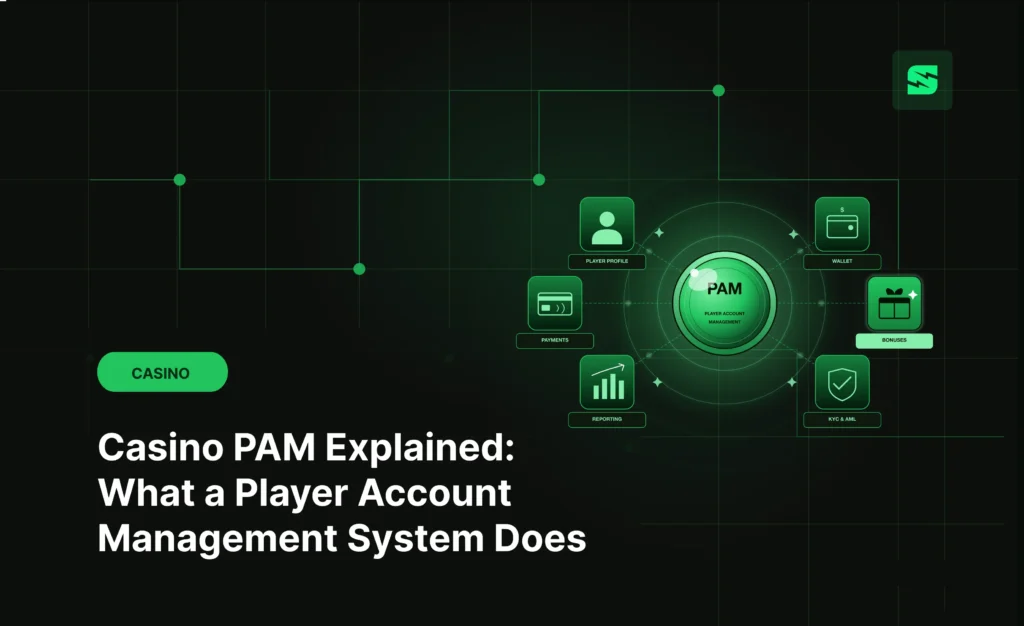
A casino player account management (PAM) system is the back-end software that manages every player account on an online casino platform. It handles registration, identity verification status, balances, transaction records, bonuses, limits, and account restrictions. The PAM connects the casino website to payment providers, game providers, KYC services, and reporting tools, and applies the operator's rules to every player action.
In short: the frontend is what players see, and the PAM is the system of record behind it. This article covers what a casino PAM does, how it works with payments and game integrations, how it differs from casino CRM software, what affects its cost, and when an operator should replace it.
What is a casino PAM system?
A casino PAM system is the back-end software that holds player accounts and the rules around them. It stores player profiles, account statuses, verification states, balances, transaction records, limits, and bonus entitlements. It also decides what a player can and cannot do at any moment.
Here is how that looks for one player:
- Registration. Client signs up. The frontend sends details to the PAM, which creates an account, checks for duplicates, and sets her status to registered, unverified.
- Verification. The PAM sends her data to an identity verification provider. Until the check passes, it can block deposits or withdrawals, depending on the operator's rules.
- Deposit. Anna pays by card. A payment provider handles the card transaction. The PAM records the deposit and updates her balance once the provider confirms success.
- Play. She launches a game from an aggregator. The game server asks the PAM for her balance, and the PAM debits each bet and credits each win.
- Withdrawal. Anna requests a payout. The PAM checks verification status, bonus wagering, and withdrawal limits, then sends an approved request to the payment provider.
How a player account management system works
A PAM sits between the platform and everything else and communicates through APIs. Most integrations fall into five groups:
Casino frontend: sends player actions (login, deposit request, game launch) and receives account data to display.
Payment providers: process deposits and payouts. The PAM sends requests and receives status updates, often through callbacks.
Game providers and aggregators: request balances, debits, and credits for each round, usually in real time.
Identity verification services: check documents, identity data, and sometimes age or address, then return a result.
Reporting and BI tools: pull account, transaction, and activity data for finance, compliance, and management reports.
One distinction matters: managing an account is not the same as moving money. When a player deposits, the payment provider or processor handles the actual funds. The PAM records that the deposit happened and reflects it in the player's balance. Where the money sits, in which bank account and under whose name, depends on the operator's payment setup and licensing conditions.
| Player side | Core system | External services | ||
|---|---|---|---|---|
| Casino frontend Website and mobile app. Sends player actions such as login, deposit, and game launch, and shows account data to players. |
⇄ | PAM system Player accounts and status Balances and transactions Bonuses and wagering Limits and restrictions Rules for every player action |
⇄ | Payment providers Process deposits and payouts, return payment status |
| ⇄ | Game aggregators Request balance, debits, and credits for each round |
|||
| ⇄ | KYC providers Check identity documents, return verification results |
|||
| ⇄ | Reporting and BI tools Pull account and transaction data for reports |
|||
Why online casinos need PAM software
Online casinos need PAM software because every player action, from login to withdrawal, depends on accurate account data and consistent rules. A PAM keeps that data in one place, applies the same logic across web, mobile, and every integrated provider, and gives operators the controls they need for support, marketing, and compliance work.
- Centralizing player data and daily operations
Without a central account system, player information ends up in separate places: payments in one dashboard, verification results in another, bonus history in a spreadsheet. A support agent handling a simple complaint then has to open four tools to answer one question.
- Improving player retention and the user experience
Retention depends on many things the PAM does not control, such as game selection, payment speed, and brand reputation. What the PAM does provide is consistency. Balances update correctly, bonuses apply as promised, and limits behave the same on desktop and mobile. When that data is accurate, offers reach the right players, which affects player lifetime value in iGaming. When it is wrong, a VIP gets a generic welcome email and a new player gets a high-roller offer.
- Supporting security and regulatory workflows
A PAM supports compliance through several functions: identity verification integrations, role-based back-office access, deposit and loss limits, self-exclusion, cooling-off periods, audit logs of who changed what, and exports for regulatory reporting. What is required depends on the jurisdiction and its current iGaming regulation.
Key features of casino PAM software
Feature sets vary by provider and architecture. The areas below are common, but check how each one works in practice rather than relying on a feature list.
Player registration and account management
This covers sign-up, login, profile edits, password recovery, and session handling. It also covers account statuses such as active, suspended, self-excluded, or closed, and restrictions such as blocking bonuses while keeping deposits open.
KYC verification and identity checks
Most PAMs do not verify identity themselves. They connect to KYC providers, send player data, and store the result. The PAM then manages statuses such as pending, verified, or documents required, and enforces rules tied to them.
For example, an operator might allow deposits up to a threshold before full verification but block all withdrawals until checks are complete. Payment processing and wallet management
Four components often get confused here:
- Payment gateway: the technical connection that passes payment data between the casino and payment networks.
- Payment processor: the company that actually executes the transaction with banks or card schemes.
- Wallet or ledger: the record of each player's balance and every movement in it, such as real money, bonus funds, and pending withdrawals.
- PAM: the system that applies account rules to payments and records them against the player.
Bonus and promotion management
The bonus engine lets operators define rules: who qualifies, how much they get, what wagering applies, which games count, and when the bonus expires. Bonus funds are usually tracked separately from cash so the system knows what can be withdrawn.
Player segmentation and personalization
Segmentation groups players by criteria such as deposit frequency, favorite game types, lifecycle stage, or recent activity. Operators use segments to target offers, adjust communications, or flag accounts for VIP or responsible gambling review.
Ready to Start Your Project?
Turn your idea into reality with expert support. Our team delivers full-cycle development.
Common casino PAM implementation challenges
Most PAM projects run into trouble at the same points: moving data out of the old system, connecting third-party providers, and switching over without stopping the casino. These problems are predictable so that they can be planned for. The sections below explain where they usually appear and how operators reduce the risk.
Migrating existing player accounts and balances
Moving to a new PAM, often as part of a wider iGaming platform migration, means transferring profiles, account statuses, transaction histories, bonus records, verification results, and balances. Fields rarely match one to one, so each needs a clear mapping rule.
Integrating legacy systems and third-party providers
Game aggregators, payment providers, KYC vendors, and CRM platforms each have their own APIs, data formats, and error handling, and older systems may lack callbacks or modern authentication. Every integration needs testing in a staging environment with realistic failure cases, such as declined deposits or interrupted game rounds.
Maintaining data accuracy during migration
Duplicate accounts, inconsistent player IDs, gaps in transaction history, and balances that don't match recorded transactions all cause problems later, from disputed withdrawals to self-excluded players slipping through. Operators reduce this risk with deduplication rules, a player ID mapping table, total and checksum comparisons, and manual checks of sample accounts.
Preventing downtime during platform updates
A PAM outage stops logins, deposits, and gameplay at once, so operators test changes in a separate environment, schedule them for low-traffic hours, and back them up with a rollback plan. Some operators migrate in phases by brand, market, or player group. The right approach depends on the current platform and how much interruption the business can accept.
When should an online casino upgrade its PAM system?
An online casino should upgrade its PAM when the system starts limiting daily operations, performance, or expansion plans. Age alone is not a reason to replace a platform. Concrete operational symptoms include.
- Managing increasing player volumes and transactions
Typical signs include new integrations that take months, staff exporting data to spreadsheets, slow month-end reports, and bonus rules the system cannot express. When several of these appear together, the platform is shaping the business instead of supporting it.
- Managing increasing player volumes and transactions
Rising traffic and more game providers can expose architecture limits through slow game launches, delayed balance updates, and timeouts during peak events. Often, operators can scale an online casino without rebuilding the platform by replacing the components that fail under load.
- Expanding into new markets or launching additional brands
New markets and brands can require extra currencies, local payment methods, languages, responsible gambling tools, and reporting formats, depending on the jurisdiction and license. If each expansion needs a workaround or a separate installation, it may be time to move to a multi-brand, multi-market PAM.
Conclusion
A casino PAM is the system of record for players. It holds the account, applies the rules, and coordinates the payment, game, and verification services around it. Most operational problems, from stuck withdrawals to misapplied bonuses, trace back to how well this layer works.
When comparing options, start with your own situation rather than a vendor's feature list. List the markets you operate in now and plan to enter. Map the integrations you rely on. Note the manual tasks your team repeats every week. Then ask each provider, or development partner, to show how their system handles those specific cases. The right choice depends on your business model, architecture, compliance obligations, growth plans, and budget.
FAQ
What does PAM mean in an online casino?
PAM stands for player account management. In an online casino, it is the back-end system that creates and manages player accounts. It stores profiles, verification statuses, balances, transaction records, bonuses, and limits. It also applies the operator's rules whenever a player logs in, deposits, plays, or withdraws.
Is a casino PAM the same as casino management software?
Not exactly. Casino management software is a broad term that can cover the whole platform, including the back office, game integrations, payments, CRM, and reporting. A PAM is one core component within that platform, focused on player accounts and the rules around them. Some vendors sell the PAM as part of a full platform, while others offer it as a standalone product that connects to other systems.
Does a PAM system hold player funds?
Usually, no. Payment providers and processors handle the actual movement of money, and where funds are held depends on the operator's banking setup and license conditions. The PAM records deposits, withdrawals, bets, and wins, and keeps each player's balance up to date. In other words, it manages the record of the money, not the money itself.
Can a casino PAM support crypto payments?
Yes, if the PAM or the surrounding platform is built for it. Crypto support usually comes through integration with a crypto payment provider or a custom blockchain payment module. The PAM then needs to handle cryptocurrencies in balances, track transaction confirmations, and apply the same limits and checks as for fiat payments. Whether crypto payments are allowed at all depends on the jurisdiction and the operator's license.
Start your project today
Scale faster with a dedicated iGaming development team that turns your vision into a market-ready product.