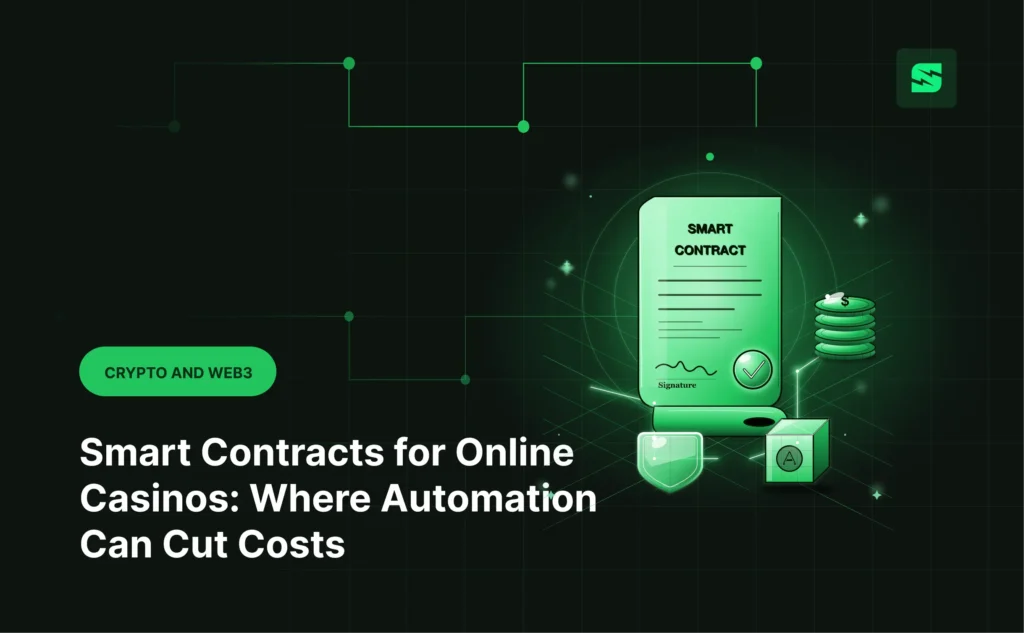
Casino smart contracts are blockchain programs that carry out a specified action, such as releasing funds, once predefined conditions are met. Online casinos can use them for eligible player payouts, bonus settlement, affiliate commissions, and jackpot distribution. The main cost opportunity is not cheaper transactions but less repetitive processing and less time spent reconciling records across systems. Those savings come with their own costs: development and integration, security audits, network transaction fees, and ongoing monitoring.
For most operators, the practical question is which specific workflows justify on-chain execution and which are better served by conventional automation. This article compares traditional casino systems with smart contract workflows and shows where automation can lower costs in deposits, payouts, bonuses, affiliate payments, jackpots, and reconciliation. It also explains which operations still need human oversight, how to implement a pilot step by step, and how to estimate net savings and payback.
How smart contracts work in online gambling platforms
A typical flow starts when a player requests a payout, and the casino's systems check eligibility, verification status, limits, and fraud signals off-chain (outside the blockchain).
If the request passes, the platform submits an authorized action to the smart contract, which checks its own coded conditions, such as who may call it, payout limits, and whether enough funds are held. Only then does the contract execute a funded transfer or settlement and record the result as a transaction.
Key differences between traditional casino operations and smart contract automation
Traditional casino platforms are not manual by default. Many already automate deposits, payouts, and bonuses through databases, rules engines, and payment APIs. The real difference is where execution happens, who controls it, how others can verify it, and where settlement is recorded. The comparisons below focus on those points.
Operational control and management
Traditional casino operations: Business rules live in the operator's backend. Admins with the right permissions can change limits, pause a payment method, or correct a balance within minutes.
Smart contract automation: Rules are deployed as contract code with defined permissions. Changing them depends on how the contract was built: some use upgradeable designs, admin roles, multi-signature approval, or a pause function, while others cannot be changed at all.
Transaction speed and payment processing
Traditional casino operations: An internal ledger updates instantly, but the money moves later. Withdrawals pass through internal checks, then card networks, bank transfers, or payment providers, each with its own settlement schedule.
Smart contract automation: Once a transfer is approved, the contract executes as soon as the network includes the transaction. Final settlement still depends on confirmation policy, network congestion, and fees at that moment. Blockchain payouts aren't automatically faster when withdrawal checks are the real bottleneck.
Transparency and fairness
Traditional casino operations: Transaction records sit in the operator's systems. Regulators, auditors, and testing labs get access under agreed terms, and players see what the operator shows them.
Smart contract automation: On a public blockchain, verified contract code and transaction history can be inspected by anyone. For background on how game results are generated, see Simpltry's explainer on how online roulette works and how RNG is tested.
Security and data integrity
Traditional casino operations: The main risks are compromised credentials, insider misuse, database errors, and weak access controls. Mistakes can usually be reversed through internal adjustments, backups, or payment provider processes.
Smart contract automation: Recorded transactions are hard to alter, but immutability only protects what was written. It does not guarantee the code is correct, the external data is trustworthy, or the signing keys are safe. A coding bug, a manipulated data feed, or a stolen key can move funds that cannot simply be pulled back.
Payout automation
Traditional casino operations: Approved withdrawals enter a payment queue, often processed through payment API integrations. Rules can auto-approve low-risk requests and route others to staff. Exception handling is flexible because staff can hold, adjust, or cancel a payment before it leaves.
Smart contract automation: The contract releases funds once valid conditions are met, without a staff member pressing a button. It only works if the contract or its connected wallet holds enough funds and per-transaction or daily limits are set.
The role of blockchain in casino automation
Blockchain in igaming adds a shared settlement record and programmable execution to a casino platform. It does not replace the player account system, the game engine, or the compliance stack. Most operators get the best results by using casino smart contracts for a few settlement steps and keeping everything else in conventional software.
Automated transactions. A contract can move funds or settle balances on its own once its coded conditions are met and any required approvals have been given. The approval itself usually comes from the operator's backend, so the contract enforces the decision rather than making it.
Transparent operations. Each executed transaction leaves a timestamped, verifiable record that finance teams and auditors can trace. That record should contain settlement data only: wallet addresses, amounts, and reference IDs. Player identities, documents, and internal risk notes belong in private, access-controlled systems.
Provably fair gaming. Some games publish cryptographic commitments or use verifiable randomness so anyone can check that a result was not changed after a bet was placed. Running a game on a blockchain does not make it provably fair on its own; the game must be designed with a verification method.
Reduced intermediaries. Contract-based settlement can cut steps such as manual payout approval, batch file handling, and some payment gateway processing. Other providers usually stay: wallet and custody services, identity verification, oracles, node or infrastructure providers, and fiat on- and off-ramps.
Ready to Start Your Project?
Turn your idea into reality with expert support. Our team delivers full-cycle development.
Smart contracts vs. traditional casino systems: cost comparison
Smart contracts rarely remove costs outright. More often, they shift spending from routine handling to development, assurance, and ongoing operation.
| Cost category | Traditional casino systems | Smart contract-based systems | What determines the difference |
|---|---|---|---|
| Initial implementation and integration | Often lower if payment and bonus modules already exist | Higher: contract development plus wallet, ledger, and compliance integration | Existing architecture, number of workflows, chosen network |
| Security reviews and audits | Standard application and infrastructure testing | Adds independent contract audits after each significant change | Contract complexity, upgrade frequency, value held |
| Payment and settlement fees | Card, bank, and payment provider fees | Network fees plus custody, node, and conversion costs | Asset used, network congestion, fiat conversion volume |
| Routine payout administration | Moderate to high where approvals are manual | Lower for in-limit requests that pass checks automatically | Share of requests needing review, limit settings |
| Affiliate and bonus administration | Handled in CRM and affiliate platforms | Lower settlement effort for stable rules, higher cost for frequent changes | How often promotions and commission terms change |
| Reconciliation and accounting | Matching across several provider reports | Simpler when transactions share IDs with the ledger | Integration quality, data consistency, retry handling |
| Infrastructure, monitoring, and maintenance | Servers, databases, payment integrations | Adds node access, on-chain monitoring, key management | Self-hosted or managed services, uptime needs |
| Compliance and player protection | Ongoing staff, tools, and reporting | Similar or higher: same obligations plus wallet screening | Jurisdiction, licence conditions, player base |
| Contract upgrades and incident response | Fixes shipped through normal releases | Slower and costlier: redeployment, migration, audit, limited fund recovery | Upgrade design, admin controls, incident playbooks |
Which online casino operations should not be fully automated?
Software can run most of the checks in these areas. What it cannot do is take accountability for complex decisions, unusual cases, or judgment calls. The goal isn't to review every case by hand, but to ensure the right cases reach a trained person quickly.
KYC and AML verification
Identity checks, sanctions screening, and transaction monitoring can be largely automated, but compliance staff still need to investigate and report suspicious or inconclusive cases.
Responsible gambling and player protection
Deposit limits, self-exclusion, and time-outs must apply instantly across every system, so the backend has to block a transaction before it reaches the chain. Automated triggers can flag risk, but interventions and support conversations need trained staff who understand the context.
Dispute resolution and fraud investigation
Account takeovers, disputed game results, bonus abuse, and technical failures all need someone to inspect the evidence and decide what happened. Because completed blockchain transfers usually cannot be reversed, remedies such as compensation or account adjustments need documented procedures before launch.
Regulatory reporting and compliance oversight
Systems can collect transaction data and prepare draft reports, but interpreting rules, validating figures, and approving submissions remain tasks for accountable humans. A public transaction record does not meet reporting obligations on its own, since regulators expect specific formats, private player-level detail, and staff sign-off.
Where smart contracts can reduce online casino operating costs
Smart contracts save money only where they replace repetitive manual work. For each workflow below, you'll see the task today, how automation changes it, what costs it may cut, and what work remains.
Automated player deposits and withdrawals
Existing task: Payment staff or scripts match incoming crypto transfers to player accounts, chase deposits sent without the right reference, and post approved withdrawals to the ledger.
What it may reduce: Time spent matching deposits by hand and fixing misallocated funds.
Faster payout processing and reduced manual work
Existing task: Winnings above a threshold wait in a queue until someone reviews and approves them, even when nothing about the request is unusual.
What it may reduce: Routine approvals, queue management, and the support tickets that slow payouts generate.
Automated bonus and promotion management
Existing task: CRM and bonus engines assign offers, track wagering requirements, expire unused bonuses, and convert bonus funds to cash.
What it may reduce: Disputes over whether a reward was paid and some manual settlement work.
Smart contract-based affiliate commission payments
Existing task: Affiliate managers calculate commissions, agree on payable balances, handle disputes, and send monthly payments.
What it may reduce: Payment processing effort and "where is my payment" disputes after an amount is agreed.
Automated jackpot and prize pool distribution
Existing task: Teams track pool contributions, confirm winners, and distribute prizes, sometimes across many players or tournament ranks.
What it may reduce: Manual allocation work and questions about how much is in the pool.
Reduced administrative and reconciliation costs
Existing task: Finance teams match records between wallets, player accounts, payment providers, and accounting software, and chase gaps.
What it may reduce: Hours spent on monthly close and investigating mismatches.
How much can smart contracts save an online casino?
There is no universal savings percentage. The result depends on transaction volume, how much of the workflow is already automated, how much manual handling remains, exception rates, network fees, integration complexity, and ongoing assurance costs.
| Cost category | Traditional systems | Smart contract systems | What drives the difference |
|---|---|---|---|
| Implementation | Lower if modules exist | Higher: contracts plus integrations | Architecture, scope, network |
| Security audits | Standard app testing | Adds contract audits per change | Complexity, value held |
| Payment fees | Card, bank, provider fees | Network, custody, conversion fees | Asset, congestion, fiat volume |
| Payout admin | High with manual approvals | Lower for in-limit requests | Share needing review |
| Affiliate and bonus admin | Run in CRM tools | Cheaper for stable rules only | How often rules change |
| Reconciliation | Many reports to match | Simpler with shared IDs | Integration and data quality |
| Infrastructure | Servers and databases | Adds nodes, monitoring, keys | Managed or self-hosted |
| Compliance | Staff, tools, reporting | Same or higher, plus wallet screening | Jurisdiction, licence terms |
| Upgrades and incidents | Normal code releases | Slower, costlier, hard to reverse | Upgrade design, playbooks |
What casino smart contracts are best for
Casino smart contracts work best when a task is high-volume, follows fixed rules, and moves funds that more than one party needs to verify. In practice, that points to a short list of workflows:
- Crypto payouts within set limits. Routine withdrawals that pass off-chain checks can settle without manual approval.
- Jackpots and prize pools. A contract-held pool with coded allocation rules makes it easy to show how each prize was split and paid.
- Affiliate and partner settlements. Once the payable amount is approved, scheduled payouts leave a record both sides can check.
- Stable reward programs. Cashback or loyalty rewards with rules that rarely change can be settled by contract.
- Provably fair game settlement. Games built with cryptographic verification or verifiable randomness can settle bets against a result players can check.
They are a weaker fit for fiat-only operations, low transaction volumes, promotions that change often, and anything that involves personal data or judgment calls.
How to implement smart contracts in an online casino platform
The steps below follow a pilot-first approach. Each one ends with a deliverable you need before moving on.
Identify high-cost processes for automation
Start with data, not technology. For each candidate workflow, measure monthly transaction volume, staff handling time, exception rates, error rates, and current cost.
- Deliverable: A baseline cost sheet and a pilot scope with measurable targets.
Choose the right blockchain network
Compare networks on transaction fees, confirmation behavior, security assumptions, supported assets (including stablecoins), wallet compatibility, infrastructure reliability, privacy needs, and developer tooling.
- Deliverable: A short network decision record explaining the choice and the trade-offs accepted.
Design and develop smart contract logic
Define the payout conditions, who can submit actions, access controls, balance handling, per-transaction and daily limits, emitted events, and what happens when a call fails.
- Deliverable: A written specification and contract code ready for testing.
Integrate smart contracts with casino infrastructure
The contract must connect to the player account system, wallets or a custody provider, payment orchestration, compliance tools, game providers, the affiliate platform, accounting, and support tools.
In plain terms, the integration must prevent the same payout from being sent twice, retry safely when a transaction fails, and keep the casino ledger in step with what actually happened on-chain.
- Deliverable: A working integration in a test environment with documented failure handling.
Test, audit, and deploy smart contracts
Test business rules, integrations, and adversarial scenarios such as replayed requests, manipulated inputs, and drained balances. Commission an independent security review, then deploy in stages with low limits and close monitoring.
- Deliverables: an audit report, deployment checklist, monitoring dashboards, and a pilot review against the original targets before any expansion.
Conclusion
Casino smart contracts can cut routine work in a few specific places: in-limit payouts, stable bonus and affiliate settlement, jackpot distribution, and reconciliation. The savings come from fewer manual approvals and cleaner records, not from blockchain being cheaper by default.
The workflows worth moving on-chain are high-volume, rule-based, and require a shared settlement record. Compare each one against improvements to your existing software, and measure total operating cost, including audits, fees, and monitoring.
If you are weighing where automation fits your platform, Simpltry's team can talk through your workflows and a pilot scope.
FAQ
Are casino smart contracts suitable for every online casino?
No. They make the most sense for operators with meaningful crypto transaction volume, stable settlement rules, and a reason to keep a shared, verifiable payment record. Casinos that mainly process fiat, run low volumes, or change rules often will usually get better value from improving their existing payment and bonus software.
Can smart contracts automate all casino payouts?
Not all of them. A contract can only pay out when the request is eligible, the contract or its wallet is funded, the game result or other input has arrived from a trusted source, the asset is supported, and the amount is within set limits. Anything that fails those conditions moves to a pending state and needs review.
Are smart contract casino payouts instant?
Not always. Operator checks may take seconds or longer; the transaction then needs network confirmations, and fees or congestion affect timing. If the player converts crypto to fiat or withdraws to a bank, that adds more time outside the contract's control.
Do smart contracts replace KYC and AML checks?
No. A contract can act on an approved status signal from your compliance system, but identity verification, transaction monitoring, investigations, and reporting remain separate responsibilities. Personal data should stay in private systems, not on a public chain.
Build player trust into your casino
Plan smart contracts, payout rules, and on-chain features around your casino’s performance and business needs.