AI personalization in online casinos uses player behavior data, machine learning, and business rules to decide which games, offers, and messages each player sees. It works as a pipeline: player events are combined into a unified profile, models rank content or estimate churn risk, and eligibility rules check permissions and restrictions before anything reaches the player.
This guide explains how that pipeline works, which personalization strategies operators can build, and how to measure whether they improve player retention.
What is AI personalization in online casinos?
AI personalization combines rule-based segmentation, predictive machine learning, and recommendation systems to decide which games, messages, and offers a specific player sees.
Decision rules sit around all of them, and generative artificial intelligence is an optional layer for wording and conversation, not a requirement.
How AI turns player data into individual gaming experiences
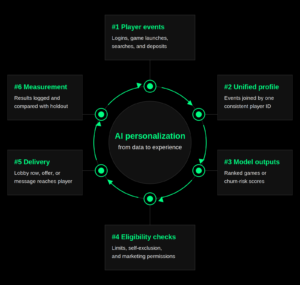
The process starts with events such as logins, game launches, searches, and deposits, which are joined into a unified player profile through a consistent player ID. Models read that profile to produce outputs like a ranked list of games or a churn-risk score, and decision rules then check eligibility, limits, self-exclusion status, and marketing permissions before anything reaches the player.
Each delivered recommendation or message is logged so the team can measure whether it changed behavior.
How AI analyzes player behavior to understand preferences
Behavioral analysis works on what players do on the platform, and its output is always a probability. A model can estimate interest or risk, but it cannot know a player’s intentions.
- Tracking game preferences, session patterns, and player interactions
Casino platforms track signals such as game types opened, time spent per game, skipped lobby tiles, searches, and usual login times, collected from the frontend, game aggregator, and PAM. Each source must use the same player ID and timestamp format, because missing, duplicated, or misattributed events distort every model built on that data.
- Identifying changes in player behavior through machine learning
Change-detection models compare a player’s recent activity with their own baseline to flag shifts, such as fewer weekly sessions or a move from slots to live tables. A flag means the player needs a review, not that they are unhappy, and possible signs of harm, such as rapidly rising deposits, should pause promotions and route the case to the safer gambling team.
- Using historical data to predict future player preferences
Predictive models learn from past behavior, such as which games players opened after a given title, to estimate what a player is likely to try next. Their accuracy declines when the catalog or market changes, so teams monitor model drift and retrain when performance drops below an agreed threshold.
- Building dynamic player profiles from multiple data sources
A dynamic player profile combines PAM account data, CRM campaign history, aggregator game activity, and analytics events into one record that updates as new data arrives. The PAM should remain the source of truth for identity, status, and restrictions, as shown in this guide to how player account management systems work, with restriction flags updated in near real time and preference data refreshed in batches.
Ready to Start Your Project?
Turn your idea into reality with expert support. Our team delivers full-cycle development.
Key AI personalization strategies used by online casinos
Online casinos use five main AI personalization strategies: game recommendations, dynamic interfaces, personalized bonuses, tailored communication, and adaptive loyalty rewards. Each one changes a specific part of the player experience and needs a control the operator can test or override.
Personalized game recommendations based on player interests
A casino recommendation engine ranks games in a “picked for you” lobby row using the player’s play history and similarities between games. A diversity rule and manual pinning keep the row from filling with the same popular titles and let operators promote launches or follow market restrictions.
Key benefit: Players reach relevant games faster, and titles from smaller providers get a fair chance to be discovered.
Dynamic casino interfaces based on individual preferences
Dynamic interfaces adjust category order, default tabs, and search suggestions, so a live casino regular lands on live tables instead of a slot-heavy homepage. Navigation, account settings, and responsible gambling tools should stay in fixed places, with a cached default layout if the personalization service fails.
Key benefit: Fewer clicks between login and the first game make the platform feel faster without infrastructure changes.
Personalized bonuses and promotions based on player activity
Personalized promotions match offer type and timing to player habits, such as free spins on a provider the player already enjoys. The bonus engine must first confirm eligibility, jurisdiction rules, budget caps, and clear terms, and no offer should be triggered by losses or signs of vulnerability.
Key benefit: Less bonus budget is wasted on blanket campaigns that many recipients ignore.
Tailored communication across email, push notifications, and in-platform messages
Tailored communication picks the channel, timing, and content of each message, such as an in-platform note about a new release from a favorite studio. The CRM must check channel permissions, frequency caps, opt-outs, and self-exclusion at the moment of sending.
Key benefit: Fewer, more relevant messages reduce opt-outs and protect sender reputation for future campaigns.
Adaptive loyalty programs and personalized rewards
Adaptive loyalty programs show each player the rewards they are most likely to value, such as game-specific perks or priority support instead of cash bonuses. Tier and point rules stay published and identical for everyone, so personalization changes which rewards appear, not how they are earned.
Key benefit: Non-cash rewards can build loyalty at a lower cost than repeated deposit bonuses.
AI technologies behind personalized casino experiences
These techniques solve different problems and are usually combined rather than treated as alternatives. Rule-based segmentation and hard eligibility rules surround all of them, because a model score should never override a restriction.
| Technology | Role | Casino example | Limitation |
|---|---|---|---|
| Content-based recommendations | Match games by attributes | "More like this" row | Repeats similar titles |
| Collaborative filtering | Rank games by similar players | "Players also play" row | Weak for new games and players |
| Predictive models | Estimate preferences or churn risk | Target new-release messages | Drift over time |
| Clustering | Group players by behavior | Find weekend live dealer fans | Needs human interpretation |
| Contextual ranking | Reorder by device and session | Quick-play games on mobile | Needs real-time data |
| NLP and generative AI | Adapt approved wording | Support assistant, CRM copy | Not personalization on its own |
AI personalization across different casino player segments
The same recommendation model can serve every segment, but the defaults, fallbacks, and limits around it should differ.
Personalization for new players during onboarding
New players have almost no history, which creates a cold-start problem for any model. A short optional preference step, such as choosing favorite game types, provides explicit signals, while curated or market-level popular lists fill the gap until activity accumulates.
Engagement strategies for active and returning players
Session-aware ranking can restore context from the last visit without nudging anyone toward longer play. The useful test is whether players find what they want faster, measured by time to first game launch or search abandonment.
Re-engaging inactive players with relevant communication
An inactive player is not automatically a problem, since some take planned breaks or use cooling-off tools. Send reactivation messages only to players with valid marketing permission, no active restrictions, and a relevant reason to hear from the operator, such as a new release in a category they played.
VIP player experiences and individual loyalty programs
VIP personalization usually covers service preferences, such as a preferred contact channel or a dedicated account manager, alongside a loyalty program with published rules. Teams can connect VIP workflows to the responsible gambling tools they already run, so managers see restriction flags before contacting a player.
Recognizing player preferences without relying on basic demographics
Age band or country says little about whether someone prefers crash games or blackjack, so stronger systems rely on observed behavior and explicit choices like favorites or saved filters. Teams should review recommendation outcomes across markets and player groups to catch skewed results.
How online casinos measure the effectiveness of AI personalization
Each metric answers a narrow question, and none alone proves that personalization caused an improvement.
Player retention rate and churn rate. Retention is the share of a defined cohort that completes a qualifying activity, such as a real-money session, within a set window, and it is also the basis for calculating player lifetime value. Exact-day retention counts players active on day 30, while return-within-window retention counts anyone who came back by day 30.
Session frequency and average session duration. Session frequency shows how often players log in, and average duration shows how long each session lasts. Both are descriptive metrics, because longer or more frequent sessions can signal risky play as well as a better experience.
Conversion rates of personalized recommendations. Recommendation conversion is the share of impressions that lead to a defined action, such as opening a recommended game. A click shows relevance, not better retention, so link conversions to later cohort results.
Bonus engagement and promotion performance. Redemption rates show how many players claimed an offer, but not how many would have played anyway. Incremental results against a holdout group, minus bonus costs, show whether a promotion actually paid off.
Challenges of implementing AI personalization in online casinos and how to avoid them
Most personalization problems come from data and governance, not model choice. Each challenge below has a practical fix and a way to confirm it works.
Collecting and integrating player data from different systems
Challenge: PAM, CRM, game aggregator, payment, and analytics tools often use different player IDs, event names, and time zones. This breaks data joins, inflates counts, and feeds models with an inaccurate picture of player activity.
How to avoid it: Use a shared event schema, one player ID mapped across systems, and versioned API contracts, with validation and deduplication at ingestion. Daily reconciliation reports confirm that data from each source matches.
Maintaining accurate and up-to-date player profiles
Challenge: Profiles go stale when batch jobs fail, duplicate accounts merge incorrectly, or restriction changes arrive late. An outdated profile can show irrelevant content or, worse, send an offer to a player who has self-excluded.
How to avoid it: Add freshness timestamps to each attribute, update restriction flags in near real time, and show a default experience when key data is missing. Alerts on failed jobs and data age show when a profile can’t be trusted.
Balancing personalization with data privacy requirements
Challenge: Personalization tempts teams to collect everything, including support transcripts and identity documents. This creates legal risk and damages player trust if sensitive data ends up in marketing logic.
How to avoid it: Collect only the data each use case needs, restrict access by role, set retention periods, and confirm the lawful basis for processing separately from marketing consent. Regular data inventories keep sensitive information out of promotional features.
The future of AI personalization in online casinos
Some of these capabilities already exist in limited form, while others are still emerging. Each trend describes a possible platform change, not a guaranteed outcome.
Predictive personalization based on changing player preferences
Session-aware recommendations, already common in e-commerce and streaming, could let casino lobbies respond to a player’s shifting interests during a visit. The trade-off is heavier infrastructure and stricter monitoring, since faster updates also spread data errors faster.
Generative AI for more natural player interactions
Generative AI already drafts approved CRM copy and powers support assistants, and it may soon help players find games or settings through conversation. These assistants still need approved content, guardrails against making offers, and a clear handoff to human agents.
Cross-channel personalization across casino ecosystems
Operators with casino, sportsbook, and multiple brands could use one profile to keep preferences and restrictions consistent across products and devices. This depends on shared player identity and data-sharing rules that licensing and privacy laws may limit in some markets.
Privacy-first AI and more transparent data processing
Federated learning and on-device processing could reduce how much player data operators need to centralize, though their use in iGaming is still in the early stages. Operators may also need to explain why a player sees a recommendation and offer a simple way to turn personalization off.
Conclusion
AI personalization in online casinos works when event data, unified profiles, models, and decision rules operate as one pipeline. Consistent player IDs, fresh restriction data, and measurement against a randomized holdout matter more than the choice of algorithm. Player protection belongs inside that pipeline, so self-exclusion, opt-outs, and safer gambling signals always override a score. Start with one use case, prove its incremental effect, and expand from there.
If you’d like to talk through your existing platform, data sources, and first personalization use case, the Simpltry team is open to that conversation.
FAQ
What is AI personalization in online casinos?
AI personalization in online casinos uses player data, machine learning, and business rules to decide which games, messages, and offers each player sees. It typically combines rule-based segments, predictive models, and a recommendation engine. Decision rules check eligibility, market restrictions, and player protection settings before anything is delivered. Generative AI can adapt approved wording or run a support assistant, but it is not required.
How does AI personalization help improve player retention?
It can help players find relevant games faster, receive fewer irrelevant messages, and see offers that match their actual interests. Those improvements may give players more reasons to return, but the effect varies by audience, catalog, and execution. To know whether personalization caused a change, compare a personalized group with a randomized holdout over the same window. A player taking a break or using a cooling-off tool should not be treated as a failure to fix with promotions.
What player data is needed for casino personalization?
The core inputs are game launches, session start and end times, searches, lobby interactions, and deposit and bonus history. Account status, jurisdiction, restrictions, and marketing permissions from the PAM and CRM matter just as much, because they decide what a player may be shown. Every record needs a consistent player ID and accurate timestamps.
Can AI personalization integrate with an existing casino platform?
In most cases, yes, without rebuilding the platform. The usual approach streams events from the PAM, game aggregator, and frontend into a profile store, then exposes model outputs through APIs the lobby and CRM can call. The effort depends on how accessible current data is, how consistent player IDs are, and whether the CRM accepts external scores. Legacy systems without event feeds may need adapters or scheduled exports at first. Starting with a single use case, such as lobby recommendations, keeps the risk manageable.
Planning personalization for your casino?
Simpltry builds and integrates casino CRM systems that connect player data with PAM, game aggregators, and messaging tools.