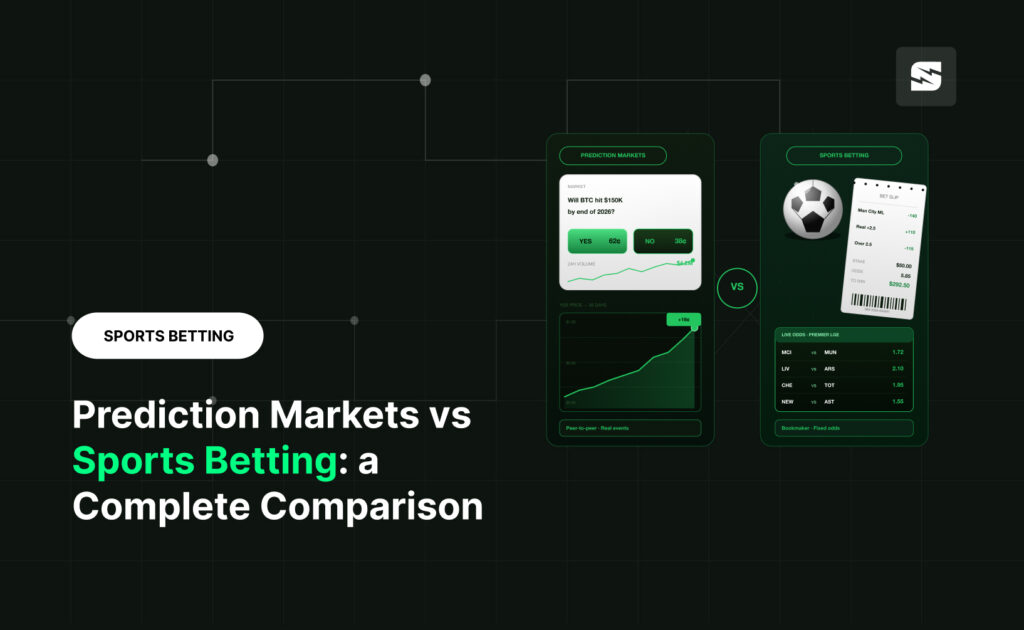
Polymarket hit over $1 billion in trading volume for the 2024 U.S. Election cycle, while global sports betting handle for the year crossed $230 billion. Both betting models involve users staking money on uncertain outcomes, but there are significant differences in their internal mechanics, regulation, and the economics they generate for operators. There are significant mechanical and legal differences that create distinctions any platform would need to consider when deciding whether to support prediction markets, sports betting, or a mix of the two.
There are numerous considerations an operator must take into account when setting up a business on the crypto infrastructure to accept customer wagers. Above all, the operator must decide between prediction markets and sports betting. Decentralized prediction markets are highly resistant to censorship and accessible to everyone. Sports betting, on the other hand, is often available across various jurisdictions and features tight spreads and ample liquidity. However, compared to prediction markets, sports betting is restricted to predicting a specific, predefined outcome. The following article will go into more detail on the key differences among market types, user behavior, and revenue. Understanding the prediction market vs sports betting model is essential for operators choosing the right product, regulatory approach, and long-term monetization strategy.
How prediction markets and sports betting actually work
By contrast, comparing prediction markets to sport betting allows for the two different ways of pricing real-world outcomes within a given market to be compared. Each market has very different mechanics, entry prices, and ways in which information affects it.
- The mechanics of a prediction market: shares, probabilities, and resolution
A prediction market consists of binary contracts (one event per contract) priced between $0 and $1. For example, a contract trading at 65c implies the crowd is 65% expecting the event to happen. Polymarket charges a tiny percentage on all trades that go through the platform, but that is the extent of the “fee” — they don’t take a cut of the contract payoffs. Unlike traditional sportsbooks, prediction market betting relies on traders continuously buying and selling contracts as new information changes the perceived probability of an event.
- How a sportsbook sets lines and manages exposure
The sportsbook model, on the other hand, starts with the odds of an outcome being set by a person (the oddsmaker). That is then overlaid with the vig or commission of the bookie. This can range from 4% to 10% and creates the house edge that remains regardless of the event's true outcome.
- Where the two models overlap, and where they fundamentally diverge
Both are systems for pricing events in this world, so prices will change when new information is released. In market-maker-based markets like prediction markets, many people with different levels of knowledge continuously update their estimates by entering trades. A sportsbook has completely different ways to manage its risk. For instance, it can move lines or put players who make a lot of money on the watch list.
Prediction markets vs sports betting: the 5 structural differences that matter
Beyond the surface-level differences in how one might place a bet, the differences between sports betting and prediction markets run deep, underpinning how each model handles risk, pricing, and market structure. This piece explores 5 fundamental differences. When evaluating prediction markets vs sports betting, operators should compare not only user experience but also liquidity, pricing models, compliance requirements, and long-term revenue potential.
Counterparty: peer-to-peer vs. house-backed
Predictions markets allow for trading between individual users in a peer-to-peer fashion or via an Automated Market Maker (AMM). So the platform does not take on any directional risk. In contrast, a sportsbook acts as a house on every wager placed on at every point in time. They take the loss as the line moves against them. Thus, sharp bettors are limited at sportsbooks.
Pricing mechanism: continuous order book vs. fixed-odds line
Prices in prediction markets change as orders are entered, and thus continue to change as more information becomes available. In contrast to prediction markets, fixed-odds sports betting is based on fixed odds, and prices are changed only reactively by the sportsbook, e.g., to balance action. By the time the sportsbook has increased the price (e.g., decreased the odds from 1.90 to 1.80), sharp money will have already driven the true probability down to this level.
Event scope: any verifiable outcome vs. sports-only focus
In prediction markets, many markets are held for future events (elections, Fed rate decisions, product launches, etc.), whereas in most jurisdictions around the world, sportsbooks are limited to markets for sporting events. Sportsbooks also offer seasonal competitions, including winter sports betting markets, covering events such as alpine skiing, biathlon, ski jumping, and ice hockey.
Profit model: trading fee vs. vig
The main distinction between how sportsbooks make money (vigorish) and prediction markets (trading fees) shapes how these platforms generate revenue. A sportsbook generates money from vigorish on every wager, regardless of wager size. In contrast, the primary manner in which Polymarket makes money is from a trading fee of 0.5% to 2% on executed trades, and therefore, the trading fee and the amount of money that is put down to participate in a market on Polymarket are the two primary determinants of the amount of revenue generated by the platform. The only factor that affects this is the liquidity available to take the other side of trades on Polymarket.
Information role: forecasting tool vs. entertainment productа
Iowa Electronic Markets research has shown that prediction markets outperform expert forecasts and polls for future election outcomes. In contrast to sportsbooks, which do not claim to be forecasting in respect of the events of sporting contests and instead concentrate on the addressable market of such events in most jurisdictions, peer-to-peer betting platforms provide a mechanism whereby dispersed information is aggregated and made available as a probability estimate with regard to future events (including those relating to elections and other political events).
Prediction Markets vs. Sportsbooks: Feature Comparison
| Feature | Prediction Markets | Sportsbooks |
|---|---|---|
| Core mechanism | Users trade contracts based on future outcomes, with prices changing as market activity and probability shifts. | Users place wagers against the operator, which sets odds and manages payouts. |
| Counterparty model | Peer-to-peer trading or AMM systems allow users to trade without the platform taking directional risk. | The sportsbook acts as the counterparty and absorbs the majority of betting risk. |
| Probability discovery | Market prices reflect collective probability estimates formed by traders responding to available information. | Probability calculations are created internally by analysts and converted into betting odds. |
| Price formation | Prices are determined by supply and demand. A contract price reflects the market's estimate of the probability of an outcome. | Odds are generated by statistical models and include a built-in bookmaker's margin. |
| Order matching mechanism | Orders are matched between buyers and sellers through order books or automated market makers. | Bets are accepted directly by the operator without requiring another participant to match the position. |
| Trading process | Users can buy, sell, hedge, or exit positions before the event ends as probabilities change. | Users usually place a bet and wait for the final result, with limited cash-out options. |
| Liquidity mechanism | Liquidity comes from traders, liquidity providers, order books, and AMM pools that support market activity. | Liquidity is controlled by the sportsbook through betting limits and risk management systems. |
| Automated market making (AMM) | Some platforms use AMM algorithms to calculate prices and provide continuous liquidity. | Sportsbooks rely on centralized pricing engines instead of AMM-based systems. |
| Price movement mechanism | Prices move automatically as users trade and new information changes market expectations. | Odds are manually or algorithmically adjusted by the operator based on risk exposure. |
| Market resolution mechanism | Outcomes are determined using predefined rules and verified through reliable data sources. | Results are confirmed using official event data and sportsbook settlement procedures. |
| Oracle and data verification | Blockchain prediction markets may use decentralized oracles or external APIs to verify outcomes. | Sportsbooks depend on centralized data providers and official sources. |
| Settlement process | Smart contracts can automatically settle markets and distribute payouts after verification. | Settlement is processed through centralized systems after results are confirmed. |
| Collateral mechanism | Users lock funds or collateral to create positions, with smart contracts managing balances. | Users deposit funds into accounts while the operator manages liabilities. |
| Risk distribution | Risk is distributed among traders or liquidity providers rather than held by a single operator. | The sportsbook manages all exposure through odds adjustments and betting limits. |
| Smart contract usage | Smart contracts automate trading, escrow funds, settlement, and payout distribution. | Traditional sportsbooks use centralized software and payment infrastructure. |
| Revenue model | Platforms earn through trading fees, transaction fees, or liquidity-related incentives. | Revenue comes from the bookmaker's margin included in betting odds. |
| Typical audience | Crypto users, traders, investors, and analysts are interested in probability markets. | Sports fans and recreational bettors are looking for traditional betting experiences. |
Regulatory landscape: where each model stands legally
Of all the factors that influence operator costs, customer access, and, in the long run, the business model’s sustainability, the regulatory status is probably the most important. Both of the business models outlined here are subject to different legal frameworks.
Sports betting regulation post-PASPA: the US state-by-state patchwork. After the 2018 PASPA repeal, sports betting spread quickly to 38+ US states, and their collective market exceeds $120BN in annual handle. The market is fragmented by state, with KYC, AML, and tax laws for each state in which a license is required to offer. As regulations expand, the online sports betting market continues to grow, creating new opportunities for licensed operators while intensifying competition across established and emerging jurisdictions.
How prediction markets navigate CFTC oversight and the Kalshi precedent. As noted, for the time being, the CFTC considers event contracts offered up for sale in platforms such as Kalshi to be derivatives (beyond simple bets), and in its 2024 ruling regarding the platform, it held that Kalshi, as a federally designated contract market, is permitted to list for sale political event contracts as if they were derivatives, among other subjects to the usual regulatory restrictions for such contracts.
Decentralized prediction markets and the offshore grey zone. As platforms that generally exist in a gray legal area, the decentralized betting platforms are more likely to deny access to users who are based in the United States than register in 38-plus states, plus DC, and risk being subject to a variety of different KYC, AML, tax, etc. burdens and heightened scrutiny as an offshore entity.
Ready to Start Your Project?
Turn your idea into reality with expert support. Our team delivers full-cycle development.
Liquidity dynamics: why depth defines user experience
As I contrast sportsbooks to two designs for prediction markets with a financial component, I will contrast two fundamentally different approaches to solving the above issue, which are referred to as “Depth of liquidity” for short.
How sportsbooks manufacture liquidity through the house model
The liquidity model adopted by Sportsbooks is synthetic. The Sportsbook operator acts as a counterparty to their customers’ wagers. This allows all wagers to be executed immediately at the market's set prices. There is no need for a counterparty (opponent) in any market, whether it is very popular or very niche.
Prediction market liquidity: AMMs, order books, and the cold-start problem
The wide spreads you see in thin-liquidity AMMs versus the fair spreads of Sportsbook liquidity in thin markets is a huge architectural difference that needs to be modeled in terms of operational complexity for any sportsbook looking to pivot to this business model.
Prediction market liquidity pools and incentive design on-chain
Both order book designs and AMMs require bootstrapping and add significant token-economic complexity on top of what the typical sportsbook would need to model for operations. The sportsbook would first need to model out this architecture gap.
Edge, skill, and information efficiency in each model
Arbitrage opportunities in both models are only worthwhile for a short period of time until the market corrects for the miscalculated probabilities.
Finding edge in sports betting: line shopping, sharp money, and closing line value
The closing line in a sportsbook is considered the gold standard for measuring the edge of a sharp bettor. For a bettor to establish a profitable edge over the long-term, the bettor must show that the sum of their edge from all of their wagers exceeds the sum of the fees that they pay to place those wagers. As such, sharp bettors who consistently have a positive closing line on their wagers are viewed by sportsbooks as a serious threat, and they have, in the past, banned the accounts of individuals who were consistently profiting from their wagers.
Information arbitrage in prediction markets: trading before consensus forms
The information in prediction markets travels fast, and, in turn, the ability to efficiently price them to capture information arbitrage before the rest of the market reaches a similar conclusion (as in the example of a political event) allows for roughly 2x returns for the trader who unlocked this information.
Why prediction markets are harder to beat for casual participants
However, studies analyzing liquidly traded prediction markets have found that prices converge to true odds within a 1-3% margin of error. This would mean that even if a trader found information that he could use to make a 2x return on investment (or pure information arbitrage) before the rest of the market caught on, the return on investment would only be roughly 30-39% (or 15-18%) as the prices would converge to true odds of 30-39% (or 15-18%) within a few percent prior to the event's resolution.
Blockchain's role: how crypto transforms both models
Crypto infrastructure alters two established business models for sports betting in different ways. The most important aspect is the location of the sportsbook operator's trust.
Smart contract resolution: removing the trusted oracle problem
Smart contract betting, such as on betting platforms, typically enables fully automated result determination by a so-called decentralized oracle, for example, UMA or Chainlink. A central betting-resolver is removed from the equation completely. This significantly compromises the trustless concept, as one single flawed oracle is sufficient to bring down the entire system.
Tokenized prediction markets: Augur, Polymarket, and Manifold compared
Augur, the first decentralized prediction market, failed to implement fair and secure resolution in practice due to its user-unfriendly design and very high gas costs. As a result, the market was served by the crypto betting platform Polymarket, a hybrid custodial platform on the Polygon blockchain that uses the stablecoin USDC. The broader category of blockchain prediction markets gained mainstream attention during the 2024 US election cycle, when Polymarket alone processed more than $1 billion in trading volume.
Crypto sportsbooks: provably fair betting and on-chain settlement
There are many projects emerging in crypto infrastructure, including crypto sportsbooks such as Stake and Cloudbet. They utilize the underlying blockchain of a prediction market for deposit functionality and the prediction market's logic for odds, but the odds are completely managed by a central figure and thus not to be trusted. So these platforms are fast but not 100% trustless.
Revenue models and unit economics: operator perspective
Operator economics for a Prediction Markets vs. Sportsbook-powered revenue model is something that we take a very in-depth look at, and we encourage any operators looking to enter the space with capital to really dive into the unit-level math to get a fair assessment of the two.
- Sportsbook P&L: hold percentage, handle, and customer acquisition cost: A good sportsbook holds 5% to 7% on handle. For a $10M handle-per-month sportsbook, this would yield $500K to $700K in gross margin before employee compensation and marketing expenses, for example.
- Prediction market platform economics: fee tiers, volume dependency, and token incentives: The fee charged by the prediction market typically averages 0.5% to 2% per annum on the volume of resolved markets, spiking temporarily for elections, major macro events, and the like, then returning to normal in less newsworthy times.
Break-even analysis: Which model scales faster for a new operator?
From an operator unit economics perspective, sportsbooks are the best bet for early cash flow, as hold on sports betting is consistent and therefore very predictable. Crypto betting from prediction markets can scale in a less linear fashion and should therefore be modeled as a supplementary product offering incremental volume and unique events.
User psychology and audience overlap between the two models
When building a Prediction Market versus a Sports Betting product, the audiences for each type of product will play a critical role in determining the product, marketing spend, and revenue for the operator.
Who uses prediction markets: the crypto-native vs. the political forecaster
In prediction markets, we see a concentration of users across three user personas: DeFi traders, macro investors, and politically engaged analysts. This group is likely to be technical and to think in terms of probability. Thus, they have a higher onboarding floor than a simple betting product. The continued growth of prediction market betting reflects increasing demand from users who prefer forecasting economic, political, and real-world events rather than wagering only on sports.
The sports bettor profile: recreational vs. professional segments
By contrast, Sports bettors are a very large and broad audience, mostly recreational, in the US alone, numbering 50 million+ active Sports bettors. Onboarding them to Prediction Markets would increase the onboarding floor by an order of magnitude or more compared to the current Prediction Markets audience.
Cross-sell potential: converting sports bettors into prediction market traders
The overlap between this group of crypto investors who bet on sports in prediction markets would be the highest-value segment to cross-sell to a sportsbook. As already mentioned, Polymarket’s X integration brings binary yes/no markets into this group's social feeds, alleviating the onboarding barrier.
Strategic opportunities: which model fits your business goals
Business opportunity for a prediction market, business opportunity for a betting platform, user base for a betting platform, and regulatory appetite for a betting platform of a DeFi-native startup.
When to build or integrate a prediction market layer
A prediction market startup would be a natural fit for DeFi-native founders, as it offers built-in wallet infrastructure, lower offshore regulatory friction, and a distinct product compared to incumbent sportsbooks. The oracle quality and market curation are the core of a defendable moat for such a business, not the smart contract itself, which can be forked by others.
When a sportsbook model still wins: scale, regulation, and brand trust
In terms of extend lifetime value of customer, building a dedicated development organization for a very specialized product (prediction markets for betting for sports in comparison to other events and markets) would not be as cost effective as filling the off-season with a betting platform for sports as a Sportsbook (as opposed to a betting platform for political and/or financial events such as stock trading in a prediction market framework for said betting for sports) for an already well-established brand that can offer its customer base said Sportsbook product through the strongly trust inspired (and licensed) distribution channel of that Sportsbook. In that case, the political and/or other financial event markets could be added to reflect the platform's retained value.
Hybrid platforms: combining sports betting and prediction markets under one roof
On the other hand, it’s possible to design a hybrid betting platform for both sportsbook customers and prediction market enthusiasts. But note that adding regulated betting across various jurisdictions to an existing blockchain sports betting project will introduce significant complexity. Here you can start to research legal advice for starting a business as a founder for regulated betting in various jurisdictions, and here you can research various product-specific breakdowns for prediction market integrations by founders.
Conclusion
There are significant differences between sports betting and prediction markets in terms of regulation, liquidity generation, revenue, and the edge a model can achieve. To provide proven unit economics for mass recreational customers with deep liquidity from the get-go, sports betting is the way to go. If, however, you are targeting information-driven customers and want to build a platform off of the sports betting model in a space of high regulatory ambiguity that a seasoned builder can exploit quickly using blockchain technology to greatly reduce the cost of settlement and bring cross-border to traditional platforms, then a prediction market is the way to go. Both spaces are currently undergoing a major revolution driven by the advent of blockchain technology.
FAQ
What is the main difference between prediction markets and sports betting?
Prediction markets are markets for predicting future outcomes (such as the result of a coin flip or an election), where participants trade on the outcome through contracts that pay out based on a verifiable true outcome. The market price reflects traders’ best estimate of the probability that the contract will expire in the money. By contrast, sportsbooks are for betting on future outcomes of sports matches where the bettor takes on the bookmaker, who offers a fixed likelihood of winning with an associated return. Most online sportsbooks are managed by a single physical entity that acts as the counterparty for all bets, making a margin on the spread of bets and, importantly, controlling liability.
What is a betting market?
A betting market is a marketplace where users wager on the outcome of a specific event. In traditional sportsbooks, betting markets are created and priced by bookmakers using fixed odds. In prediction markets, prices are determined by participants trading contracts, allowing probabilities to update dynamically as new information becomes available.
How does liquidity work in decentralized prediction markets compared to traditional sportsbooks?
A sportsbook functions as a ‘house’ and takes both sides of a trade, enabling customers to place wagers on a sports market in which to place bets. In contrast, a blockchain-based prediction market does not operate in this manner and instead forms thin markets that operate on a peer-to-peer basis, employing order matching or an Automated Market Maker (AMM) to determine market prices and add new liquidity. The greatest single challenge currently facing the use of a blockchain-based platform for prediction markets is bootstrapping the market with low initial participation and achieving sufficient spread and accuracy to drive wide adoption.
Are crypto sports betting platforms legal in the United States?
US Crypto Sports Betting — Legal Status by State. In the US federal arena, there are very few laws relevant to the crypto sports betting industry. Rather, it is the patchwork of state laws that have developed since PASPA (Professional and Amateur Sports Protection Act) was lifted in 2018. While many states now allow some form of sports betting and permit users to place bets with permitted cryptocurrencies, many others prohibit sports betting of any kind. In many cases, offshore crypto sportsbooks will allow users from the US to sign up for accounts in complete legality, however, this would be to be in complete legality as the sportsbook would not be licensed in any state or country and would be subject to the same strict rules regarding the verification of customers (KYC) and financial transactions (AML) as are applied to all other online financial products.
Does skill actually give bettors an edge in prediction markets?
Prediction markets can be far more skill-rewarding than sports betting for the simple reason that there is no house margin to erode the returns of a skilled trader in a prediction market, just as there is no house margin to erode the returns of a skilled trader in financial markets that are amenable to arbitrage. Every bet in sports betting, for instance, is subject to a house margin, even for the most accurate of bettors. In contrast, a sophisticated trader with information or a superior model can expect to make a steady return in well-liquid prediction markets.
Which platform fits your business — a prediction market or a sportsbook?
Our team builds both, tailored to your brand, audience, and regulatory needs.