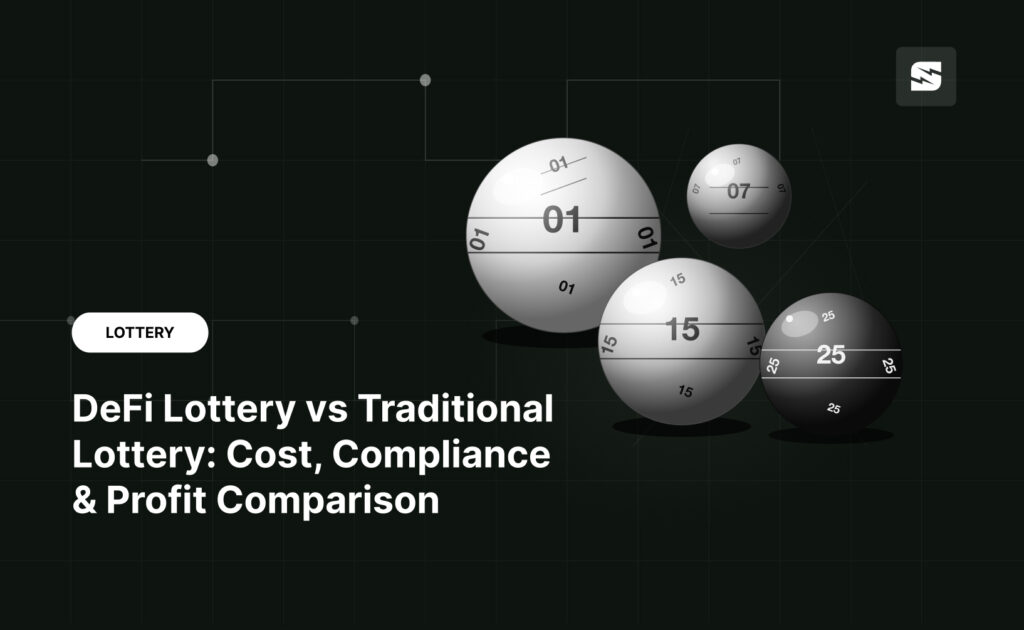
DeFi lotteries and traditional lotteries use very different approaches to payments, transparency, and regulation. For businesses, the better option depends on factors such as operating costs, compliance requirements, control, and potential returns.
This article compares both models across cost, compliance, profitability, and technology, and looks at how white-label casino platforms can offer a faster alternative to building a system from scratch.
Traditional Lottery vs DeFi Lottery: How Each Model Operates
Although both models are designed to sell lottery tickets and award prizes, the journey from player entry to winner payout is very different.
| How the lottery works | Traditional Lottery | DeFi Lottery |
|---|---|---|
| Joining the game | Players buy tickets through licensed websites or retail outlets. | Players connect a crypto wallet and purchase entries directly on-chain. |
| Managing entries | The operator stores and manages all ticket information. | Smart contracts automatically record every entry on the blockchain. |
| Selecting winners | Winning numbers are drawn using certified lottery systems. | Randomness is generated through blockchain-based verification services. |
| Paying prizes | The operator validates claims before transferring winnings. | Prize distribution is executed automatically by smart contracts. |
| Who controls the system? | A licensed organization manages the entire lottery process. | Core functions are governed by blockchain code and decentralized infrastructure. |
| How players build trust | Trust comes from regulation, audits, and the operator's reputation. | Trust comes from transparent transactions and publicly verifiable smart contracts. |
How to Choose Your Lottery Mode: 5 Questions to Ask Before You Build
Before deciding whether DeFi is right for you or whether you should continue using the traditional approach, it’s extremely important that you determine which option best fits your business plan. This, of course, depends on a number of factors, including your target audience, budget, etc.
Who is your target player — crypto-native or mainstream consumer?
The choice must be based on your audience's needs. Crypto people will definitely need some blockchain-related features, such as wallet integration and transparency, while the latter may expect features like easy registration and familiar payment methods that facilitate user-friendly development.
What's your available capital — and how much can you afford to lose?
Any platform—especially one designed for running giveaways—requires an investment, but that investment will depend on which platform you choose. You should consider all potential costs connected with developing such systems, not just those directly related to their creation.
Which jurisdictions do you need to operate in?
Since lottery regulations vary from state/country, compliance with these rules is an important part of business planning. Determining which region your company will operate in will help you choose the most suitable model.
How important is provable fairness to your brand?
Player trust is critical in guaranteeing long-term business growth. In traditional sweepstakes, transparency is ensured through government oversight, whereas in social or sweepstakes casinos that use blockchain technology and smart contracts, verifiable results are guaranteed by the fairness of the random number generator.
How fast do you need to go to market?
Your launch timeline may affect the development of the chosen product. Although each project has its own implementation needs, planning ahead will help you avoid unneeded complications and accelerate your time-to-market.
Startup Cost Comparison — What It Takes to Launch Each Model
Although both business models generate revenue from lottery ticket sales, they require investment in very different areas. Traditional operators spend more on licensing and physical operations, while DeFi projects invest heavily in technology before launch.
| Before launch, you'll need to invest in... | Traditional Lottery | DeFi Lottery |
|---|---|---|
| Legal preparation | Licenses, permits, regulatory approvals. | Legal review of tokenomics and supported jurisdictions. |
| Technology | Lottery platform, payment systems. | Smart contracts, wallet integration, blockchain infrastructure. |
| Security | Internal fraud prevention. | Contract audits and penetration testing. |
| Operations | Staff, retailers, and customer support. | Protocol monitoring and developer support. |
How Traditional Lotteries Split Revenue
Every ticket sold supports more than just the prize pool. Traditional lottery operators divide revenue across several operational areas that keep the business running and compliant with local regulations.
| Revenue destination | Why it's part of the business |
|---|---|
| Prize fund | Pays winners and maintains player interest. |
| Distribution network | Compensates retailers and sales partners. |
| Business operations | Fund employees, infrastructure, and support. |
| Regulatory costs | Covers licensing, audits, and legal obligations. |
How DeFi Lotteries Split Revenue
Without physical stores or ticket distributors, a DeFi lottery allocates revenue differently. Most funds remain within the protocol, supporting automation, network activity, and long-term ecosystem development.
| Where protocol revenue goes | Why it matters |
|---|---|
| Prize distribution | Automatically rewards winning participants. |
| Protocol treasury | Finance upgrades and future development. |
| Network execution | Pays blockchain transaction and processing costs. |
| Community incentives | Encourages user participation and ecosystem growth. |
Security and Functional Risk Profile
Every lottery system, including those that use blockchain, is susceptible to both security and functional risks; however, the risks it faces depend on the technology used.
Traditional Lottery Risks — Insider Fraud, Retail Theft, System Outages
Traditional lottery systems may face issues such as insider fraud, ticket theft, payment disputes, inefficiencies, and system errors that cause downtime, which can potentially be mitigated by implementing blockchain technology.
DeFi Lottery Risks — Smart Contract Exploits, Oracle Manipulation, Bridge Hacks
DeFi gambling systems face additional risks, including smart contract vulnerabilities, manipulation of external data sources, challenges associated with blockchain in iGaming, issues related to smart contract and bridge development, and security concerns arising from the inherent randomness of blockchain-based systems.
Ready to Start Your Project?
Turn your idea into reality with expert support. Our team delivers full-cycle development.
Licensing and Compliance Cost Breakdown
Compliance spending isn't concentrated in one area. Instead, it is spread across legal preparation, operational controls, security, and ongoing reporting.
| Budget category | Typical spending includes | More common in |
|---|---|---|
| Government approvals | Licensing applications, legal documentation, and regulatory reviews. | Traditional lotteries. |
| Identity verification | KYC systems, AML checks, and customer verification tools. | Both models. |
| Technical assurance | Smart contract audits, penetration testing, and code reviews. | DeFi lotteries. |
| Regulatory maintenance | Reporting, license renewals, and compliance monitoring. | Traditional lotteries. |
| Legal adaptation | Updating policies as regulations evolve across different markets. | Both models. |
When Traditional Lottery Makes More Business Sense
A lottery is the preferred option for enterprises that need stability and are concerned about future development and growth. This type of lottery is ideal for organizations that wish to build a reputable brand in well-established markets.
You're consumers in regulated Western markets
If your target market is in countries with existing government regulations for running games of chance, standard models are likely your best choice.
You have $1M+ in capital and a 5–10 year
Gambling entails the expenditure of much of one’s time, aside from the many deficiencies that the business process has. Organizations with sufficient funds and plans should be able to undertake such projects.
You want defensible cash flow
Traditional sweepstakes can provide stable, predictable revenue if you have an active, faithful player base. That is why such sweepstakes attract companies seeking long-term future growth.
You want institutional partnerships
Government, banks, and commercial organizations will be more familiar with how conventional games of chance work than with their online counterparts.
When DeFi Lottery Is the Smarter Bet
DeFi lotteries, along with staking options, smart contracts, and competent governance, can also be an ideal option for firms seeking fast deployment, reaching blockchain users, and engaging participants on a globally accessible platform, distinguishing themselves in the DeFi lottery vs traditional lottery debate.
- You have under $500K in capital
Since you don't need to spend a lot of money on running a DeFi lottery, which regularly incorporates smart contracts, it's a reasonable solution for startups and companies with smaller budgets.
- Your target audience is already in Web3
If your users are familiar with cryptocurrencies, use the best crypto wallet for gambling, and actively engage with blockchain apps, a DeFi lottery is likely to meet their expectations.
- You want to iterate fast
Platforms based on blockchain technology can be updated and developed faster than those used in the lottery industry, enabling companies to accelerate development, roll out new products quickly, and keep up with changes.
- You want global distribution from day one
DeFi platforms, powered by blockchain technology, have no spatial barriers and can attract users from different markets without requiring physical tickets or stores, often using RNG to guarantee fairness, as in a lottery.
Conclusion
Every business has its own ideal gambling model. Traditional games offer advantages such as reliability, regulation, and significant growth prospects; at the same time, decentralized financial gambling handles these shortcomings, providing greater transparency, improved management, rapid growth, and wider global prospects.
FAQ
Is a DeFi lottery cheaper to launch than a traditional one?
There are many cases where launching a DeFi lottery is much more cost-effective than launching a traditional lottery, since there is no requirement for physical ticket production or distribution, nor for supporting a large staff. At that, blockchain can help automate manual processes in traditional systems, reducing inefficiencies. However, despite reduced launch costs, there is still a need to invest in developing, maintaining, operating, marketing, etc.
Which model has higher profit margins?
There is no definitive answer, as it relies on factors such as operating costs, player numbers, marketing, transactions, etc. Traditional lotteries have an advantage due to stable revenue from loyal customers, while automated, decentralized DeFi systems can cut operating costs. Successful companies could achieve high profitability regardless of the models they choose.
How long does it take to launch each type?
It all depends on the project's complexity and the required level of compliance. Decentralized financial gambling projects are developed faster because no hardware is required, and many development processes are automated by blockchain technology. Traditional projects take significantly longer to implement because they involve processes such as licensing and compliance checks.
What's the minimum budget to launch a DeFi lottery?
This can vary depending on your specific project. Total funding requirements will depend on factors such as platform complexity, chosen blockchain, security reviews, regulatory compliance, launch support, etc. While creating a simple DeFi lottery may require less funding than an enterprise-level platform, companies still need sufficient funds to cover all development costs.
Launch Your Lottery Platform
Build a traditional or DeFi lottery with a solution tailored to your business goals.